Rare Indonesian stones are not priced by beauty alone. A grape agate cluster, a slice of fossil palm wood, or a cabochon of blue amber can move from modest to premium based on factors that gemologists and collectors weigh every day. Understanding those factors helps buyers avoid overpaying and helps makers choose material that will hold value after cutting.
What "Value" Means in Collectible Stone
In the gem and mineral trade, value is not a single number. It is a composite of rarity, visual quality, durability, provenance, and trust. For Indonesian material, locality matters as much as color because many deposits are small, remote, and inconsistently worked. A stone with documented origin and stable structure can outperform a prettier but undocumented piece.
1. Deposit Rarity and Locality
Indonesia's gem-bearing regions—Sulawesi, Java, Sumatra, Banten, Maluku—sit along volcanic and hydrothermal belts. Deposits can be thin, weathered, or exhausted quickly. When a locality produces only a small volume of high-grade material, scarcity alone raises baseline value.
Why Indonesian Deposits Are Finite
Many Indonesian gem deposits are secondary: weathering and erosion concentrate minerals in soils and river gravels. Once the richest pockets are collected, later material often has lower saturation or more fracturing. That is why early, well-documented specimens from a locality can become reference pieces.
Provenance as a Value Multiplier
Provenance is the documented chain of origin and custody. For collectors, a label such as "Manakarra, West Sulawesi" or "Garut, West Java" is not trivia; it anchors identity. Stones sold with locality data, collection history, and, when possible, photographs of the rough before cutting carry more confidence. See RENDI VIRGO's specimen collection for pieces selected with locality in mind.
2. Color Saturation and Hue Stability
Color is usually the first value driver. Collectors look for saturation that is vivid but not muddy, with a hue that remains attractive under different lighting. In chalcedony and agate, even color distribution matters; in opal, play-of-color should be bright and directional rather than patchy.
Reading Color in Agate and Opal
For agate, inspect the stone under daylight-equivalent light and, if possible, incandescent light. Some Indonesian agates show strong contrast between body color and inclusions. For Kalimaya black opal, look for play-of-color that is visible face-up and not dependent on extreme tilt. Stones that require perfect lighting to show color are harder to sell and usually discounted.
3. Pattern Sharpness and Visual Composition
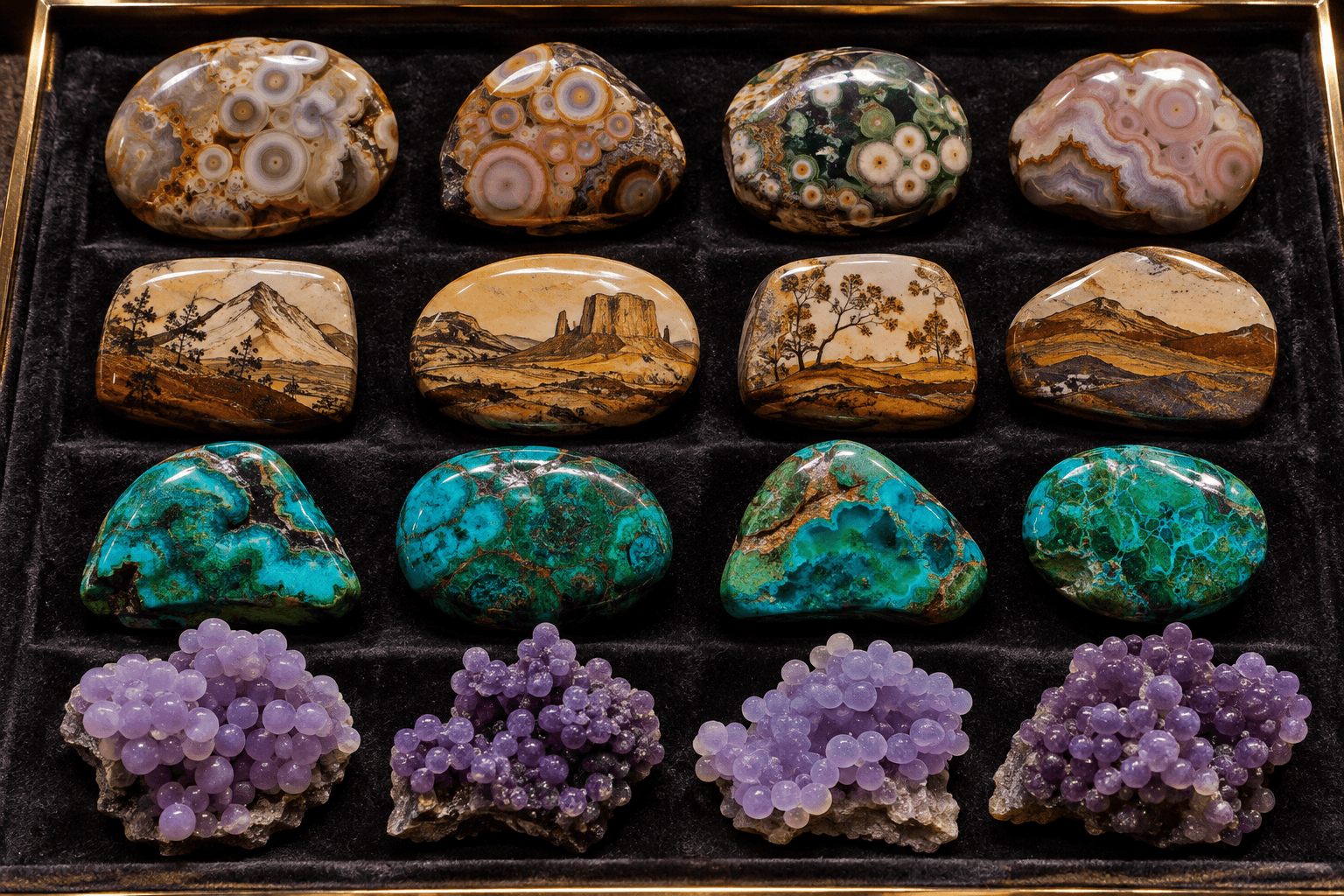
Pattern is the "art" of the stone. Dendritic agate should have crisp, high-contrast inclusions. Picture jasper should show recognizable landscape-like bands. Botryoidal grape agate should have uniform, well-formed spheres with clean separation. A sharp pattern makes a stone memorable, and memorable stones command premiums.
When comparing two otherwise similar pieces, the one with stronger contrast, better symmetry, and fewer distracting inclusions usually wins. This is subjective, but experienced buyers converge quickly on what looks "finished" even in rough.
4. Structural Integrity and Condition
Beauty cannot compensate for structural weakness. Fractures, pits, and unstable inclusions reduce both durability and value. In opal, crazing—fine surface cracking caused by moisture loss—can destroy value. In silicified wood, microscopic voids can telegraph through a polish.
Fractures, Crazing, and Stabilization
Stabilization with resin can make a stone usable, but it changes how collectors classify it. Treated or stabilized material should be disclosed and priced accordingly. Untreated, structurally sound stones remain the benchmark for valuation. If you work rough yourself, RENDI VIRGO's rough materials include pieces selected for both color and integrity.
5. Size, Cut, and Finish
Size matters only when quality is equal. A large but fractured stone is not more valuable than a smaller, clean one. For cabochons, dome geometry affects light return: a well-proportioned dome can make color appear deeper without adding weight. For slabs and carvings, orientation should respect natural pattern and grain. Poor cutting can waste a rare piece; excellent cutting can elevate an average one.
Lapidary buyers should factor labor into value. A rough piece with ideal orientation and minimal waste may be worth more than a heavier but awkward block.
6. Ethics, Documentation, and Market Trust
Modern collectors increasingly ask where a stone came from and how it was extracted. Ethical sourcing and transparent documentation support long-term value. A stone sold with clear origin, treatment disclosure, and care guidance is easier to resell and easier to insure. RENDI VIRGO documents locality and treatment status for its catalog, and offers custom lapidary services for clients who want material cut to specification.
Quick Valuation Checklist for Buyers
- Confirm locality and, if possible, collection history.
- Evaluate color under more than one light source.
- Inspect for fractures, pits, and unstable inclusions.
- Check treatment or stabilization disclosure.
- Consider cut quality and orientation, not just carat weight.
- Ask whether the piece is better as a specimen, cabochon, or carving.
FAQ
Does a certificate guarantee value?
No. A certificate documents identity and measurements; it does not set market price. Value still depends on rarity, condition, and demand.
Are treated stones worthless?
Not worthless, but they are usually valued below untreated equivalents. Disclosure and appropriate pricing are the key.
What is the safest first purchase for a new collector?
A documented, untreated cabochon or small specimen from a known locality. It teaches quality judgment without high risk.
How should rare stones be stored?
Keep them dry, padded, and away from harder minerals. Opal and hydrophane material need careful humidity control.