
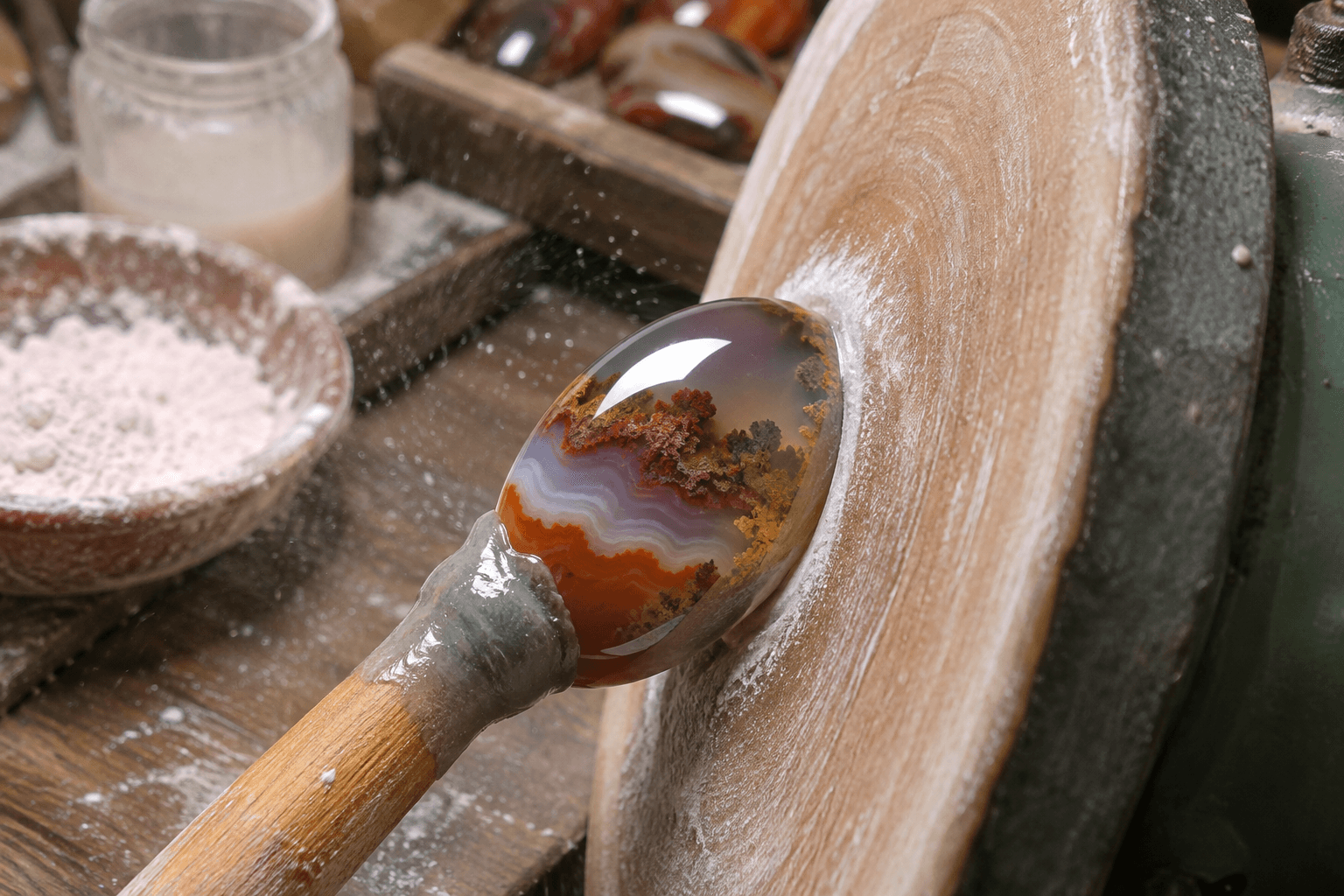
Indonesian agate is one of the most rewarding materials for a cabochon maker. From banded West Java agate and moss agate to Manakarra grape agate and Sukabumi picture jasper, the stones are hard enough to take a glassy polish and varied enough to make every piece unique. Agate is chalcedony, a microcrystalline quartz with a Mohs hardness of about 6.5 to 7.0, so it responds well to diamond abrasives and can be polished to a bright, durable finish.
This guide explains a practical workflow for polishing Indonesian agate cabochons: how to set up your tools, which grit progression to follow, how to control heat, and which mistakes most often leave a hazy or scratched dome. If you are still choosing material, start with rough lapidary stock or compare finished pieces in our cabochon collection.
What Makes Indonesian Agate Suitable for Cabochons
Agate forms when silica-rich fluids fill cavities and fractures in volcanic or sedimentary host rocks. The result is a compact, fine-grained silica aggregate with very small crystal size. That fine grain is what allows a smooth, reflective surface. Many Indonesian varieties also contain dramatic inclusions: chlorite filaments in Java moss agate, dendritic manganese and iron oxides, botryoidal cavities in grape agate, and landscape patterns in Sukabumi picture jasper.
Those inclusions are beautiful, but they can create mixed-hardness zones. A soft inclusion next to hard quartz may undercut during grinding. When that happens, slow down, reduce pressure, and let the abrasive cut evenly. For complex pieces, custom lapidary work is often safer than forcing a standard dome.
Tool Setup Before You Start
A reliable cabochon setup does not need to be elaborate, but it must be clean and consistent.
- Trim saw: A diamond blade for cutting slabs and preforms.
- Grinding wheels: Coarse wheels around 100 to 220 grit for shaping the outline and girdle.
- Sanding drums or wheels: 220, 400, 600, 1200, and 3000 grit for progressive refinement.
- Polishing lap: Leather, felt, or a dedicated polishing pad.
- Water delivery: Continuous water flow for cooling and swarf removal.
- Eye and respiratory protection: Especially when dry-finishing or cleaning equipment.
Use diamond abrasives for quartz-family stones. Silicon carbide can cut agate, but diamond is more predictable and leaves a cleaner scratch pattern. Keep coarse and fine tools physically separated. A single stray coarse grain on a polishing lap can reintroduce deep scratches at the final stage.
Grit Progression for a Glassy Dome
Polishing is the removal of progressively smaller scratches. Skipping a grit leaves scratches that the next stage cannot remove efficiently.
| Stage | Typical grit | Goal |
|---|---:|---|
| Trim and preform | 100-220 | Establish outline, thickness, and girdle |
| Coarse dome | 220 | Remove saw marks and flatten high spots |
| Medium sanding | 400-600 | Refine curvature and remove coarse scratches |
| Fine sanding | 1200 | Create an even, satin surface |
| Pre-polish | 3000 | Remove fine sanding marks |
| Final polish | Cerium oxide, aluminum oxide, or fine diamond paste | Produce a glassy, reflective dome |
Work each stage until all scratches from the previous stage are gone. Inspect under raking light and, if possible, magnification. Do not judge progress by time; judge it by scratch removal.
For cabochon geometry, keep the dome smooth and continuous. Flat spots usually come from holding the stone in one position too long. Rotate the stone steadily and use light, even pressure. A high dome can magnify inclusions and color; a low dome can make a stone look larger and more wearable. The right choice depends on the pattern and thickness of the rough.
Cooling and Pressure
Agate conducts heat poorly. Friction from grinding and sanding can raise localized temperatures enough to cause thermal shock, especially near thin edges, fractures, or drusy cavities. Always use water, keep the stone moving, and avoid heavy pressure.
Warning signs include a hot stone, steam, a burnt smell, or a sudden dull patch. If any appear, stop and let the stone cool. Repeated overheating can create microfractures that later show as crazing or a cloudy polish. This is particularly important for included material such as grape agate, where cavities and thin walls heat quickly.
Dealing with Inclusions and Mixed Hardness
Indonesian agates are rarely uniform. Moss agate filaments, dendrites, and botryoidal cavities can be softer or more porous than the surrounding chalcedony. These areas may undercut, producing a slightly recessed surface.
Practical adjustments:
- Reduce pressure over included zones.
- Use finer grits for longer rather than pressing harder.
- Orient the dome so delicate areas are not on the highest point of wear.
- Avoid aggressive polishing compounds in deep cavities.
- Do not fill cavities with resin unless the treatment is clearly disclosed.
If a stone has copper-bearing inclusions, as seen in some Garut petrified wood, treat it as a mixed-hardness material. Copper is much softer than quartz and will undercut quickly. Use finer abrasives and minimal pressure. For a broader discussion of mixed-hardness cutting, see the related lapidary guides in our blog archive and consider custom lapidary services.
Common Mistakes That Ruin a Polish
- Skipping grits. A 1200-grit surface cannot hide 220-grit scratches.
- Dry polishing quartz. Dry friction overheats agate and can glaze the surface without removing scratches.
- Contaminated wheels. Coarse grit on a fine wheel destroys a finish.
- Too much pressure. Pressure creates heat, flat spots, and undercutting.
- Poor orientation. Ignoring banding, inclusions, or cavity walls wastes good material.
- Over-polishing edges. Thin edges can round over and lose the intended dome profile.
A good polish is usually the result of patience in the middle grits, not a stronger final compound.
Finishing, Inspection, and Care
After the final polish, rinse the stone thoroughly and dry it with a soft cloth. Inspect under bright light and magnification for drag lines, haze, or undercut inclusions. If the dome is cloudy, return to the last grit that produced a clean surface and work forward again.
For care, wash finished agate with mild soap and water, then dry completely. Store cabochons separately to prevent harder stones from scratching softer ones. Avoid sudden temperature changes, especially for included or cavity-rich pieces. If a stone has fractures or delicate inclusions, avoid ultrasonic cleaning.
Collectors and makers can browse finished cabochons, rough material, and display specimens, or view the full RENDI VIRGO catalog.
FAQ
Can I polish agate with a rotary tool?
A rotary tool can handle small touch-ups, but it is hard to maintain an even dome. For consistent curvature and scratch removal, use controlled wheels or drums with a steady water supply.
What polish compound works best on agate?
Cerium oxide and aluminum oxide on leather or felt are common choices for quartz-family stones. Fine diamond paste also works well, especially when you want a very bright finish. Cleanliness matters more than brand.
Why does my agate look hazy after polishing?
Haze usually means scratches remain from an earlier grit, or the polishing lap is contaminated. Re-sand from the last clean stage and replace or clean the polishing surface.
Do all Indonesian agates polish the same way?
No. Dense banded agate is usually straightforward, while moss agate, grape agate, and cavity-rich material need lighter pressure and careful orientation. Inclusions and porosity change how each stone responds.
RENDI VIRGO sources natural Indonesian agate, cabochons, rough material, and display specimens for collectors, jewelers, and lapidary artists.