Cutting mixed-hardness stones is one of the most common challenges in lapidary work. When a single slab contains minerals with very different Mohs hardness values—such as copper inclusions in agate, pyrite in jasper, or remnant lignin in silicified wood—standard cutting and polishing routines often leave undercutting, pitting, or a dull finish. This guide explains how to read the stone, choose tools, and adjust technique so mixed-hardness material cuts cleanly and polishes evenly.
What Makes a Stone "Mixed Hardness"?
A mixed-hardness stone contains two or more minerals with different resistance to scratching and abrasion. In gemology, hardness is usually expressed on the Mohs scale, where quartz sits at 7 and copper minerals can sit near 2.5 to 3.5. When both occur in the same piece, the softer phase erodes faster during grinding and polishing.
Common Indonesian Examples
Indonesian lapidary rough often shows this behavior. Botryoidal grape agate from West Sulawesi can contain soft clay or iron oxide seams between purple quartz clusters. Jasper from Java may host hematite or goethite veins. Silicified wood and fossil coral can combine quartz at 7 with softer carbonate or clay remnants below 4. These contrasts are normal and are part of the stone's character, but they require deliberate technique.
Why Mixed Hardness Causes Undercutting and Pitting
During slabbing and grinding, abrasive particles remove softer material faster. The result is a recessed groove along a vein or inclusion, known as undercutting. During polishing, the same differential removal can leave a pitted surface or a matte patch where the soft phase never reaches the same reflectivity as quartz.
Reading the Stone Before Cutting
Before touching a saw, inspect the rough under strong light and magnification. Note the direction of veins, the size of inclusions, and whether soft material reaches the surface. A loupe or a low-power microscope is enough for most cabochon rough. If soft seams run through the planned dome, consider cutting a lower dome or choosing a different orientation so the finished face crosses them rather than following them.
Planning the Cut
Mixed-hardness material rewards conservative planning. The goal is to keep the final polished face away from the most fragile inclusions while still showing the pattern that makes the stone attractive.
Choosing Saw Blade and Speed
Use a thin, high-quality diamond blade and keep the feed rate slow. Rushing the cut increases vibration, which can fracture soft inclusions or tear them out of the matrix. Water flow should be steady but not so heavy that it hides the cut line. For small cabochon preforms, a trim saw with a fine blade is usually safer than a large slab saw.
Marking and Orienting the Preform
Mark the outline with a wax pencil or fine marker. Orient the preform so the hardest phase supports the edges and the softest inclusions sit toward the center of the dome rather than the girdle. This reduces chipping during grinding and makes polishing more even.
Grinding and Shaping
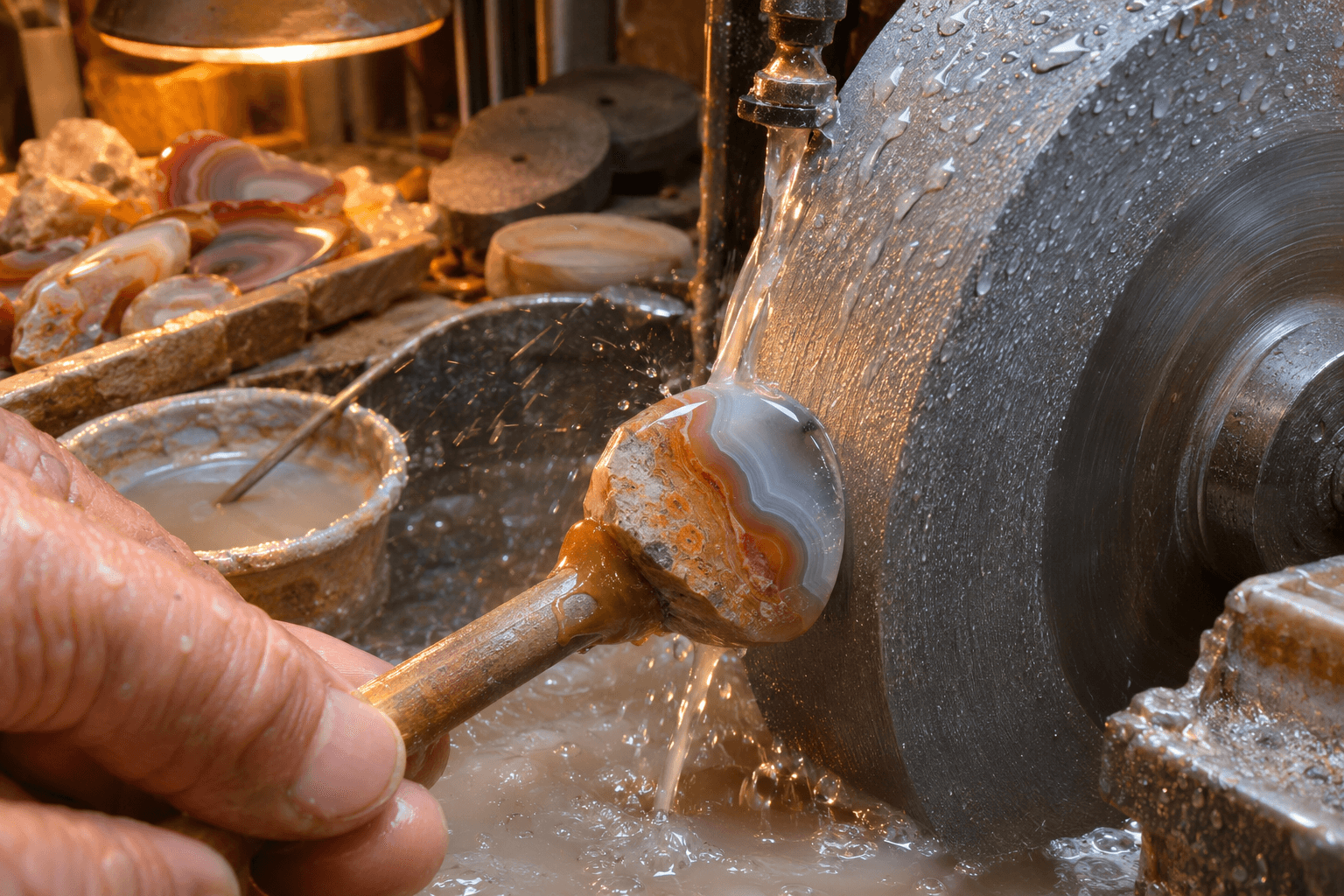
Grind in stages rather than trying to remove all material at once. Start with a coarse wheel to establish the dome, then move to medium and fine wheels. Keep the stone moving across the wheel to avoid heat buildup, especially where copper or iron minerals are present.
Wheel Grit Sequence
A typical sequence for mixed-hardness cabochons is 100 grit for shaping, 220 grit for smoothing, 600 grit for pre-polish, and 1200 grit or finer before polishing. Softer stones may need to skip the coarsest stage or use a lighter touch to avoid tearing. Always clean the stone between grits so coarse abrasive does not scratch the finer surface.
Managing Heat and Fractures
Heat is a hidden risk. Copper-bearing agate can contain micro-fractures that open when the stone warms. Work with water cooling and avoid dwelling on one spot. If a crack appears during grinding, stop and reassess; sometimes a smaller finished stone is safer than a cracked large one.
Polishing Mixed-Hardness Stones
Polishing is where mixed hardness becomes most visible. Quartz polishes to a bright vitreous luster, while softer inclusions may stay slightly matte. The aim is a balanced, attractive finish rather than a mirror on one phase and haze on another.
Polishing Compounds and Pads
Cerium oxide on a felt or leather pad is a common choice for quartz-rich material. For stones with very soft inclusions, a finer compound such as tin oxide or a diamond paste at 50,000 grit can reduce differential removal. Test on a small area first and adjust pressure. Light pressure and frequent inspection usually produce better results than aggressive polishing.
When to Stop and Re-Shape
If undercutting becomes visible during polishing, return to a finer grinding stage instead of polishing harder. Polishing harder only deepens the recess. Re-shaping the dome slightly lower often brings the soft and hard phases back into the same plane.
Care, Storage, and Value
Mixed-hardness stones deserve gentle handling. Store them separately from harder gems to avoid scratches, and avoid ultrasonic or steam cleaning when the stone contains soft inclusions or fractures. Documenting locality and treatment history adds value for collectors and supports transparent provenance. For premium specimens, a simple record of origin, mineralogy, and whether the stone is natural or stabilized helps future buyers assess quality.
RENDI VIRGO offers natural cabochons, rough material, and display specimens for lapidary projects. Browse the main catalog at /shop, explore finished stones at /shop/cabochons, source rough material at /shop/rough, or request custom cutting through /lapidary.
FAQ
Can I cut copper-bearing agate on a standard trim saw?
Yes, if the blade is diamond-impregnated and the feed rate is slow. Keep water flowing and avoid forcing the stone. If the copper is very soft or fractured, consider stabilizing the rough first.
Why does my stone undercut during polishing?
Undercutting happens because softer minerals remove faster than quartz. Reduce pressure, use a finer compound, or return to a finer grinding stage to bring the surface back into plane.
Should mixed-hardness rough be stabilized?
Stabilization with resin can help very fractured or porous rough, but it changes the stone's natural character and may affect value. For collector specimens, many buyers prefer untreated material with documented provenance.
Which grit sequence works best?
A common sequence is 100, 220, 600, and 1200 grit before polishing. Adjust for the specific stone, and always clean between stages to prevent cross-contamination.