Grape agate vs moss agate is one of the most common comparisons among collectors of Indonesian chalcedony. Both stones are silica-based, both can show striking green and purple tones, and both come from the Indonesian archipelago. Yet they form in completely different ways and reward different kinds of cutting. This guide compares Manakarra grape agate from West Sulawesi with Java moss and dendritic agate, covering mineralogy, appearance, formation, cutting, care, and value so you can choose the right stone for a cabochon, a slab, or a display specimen.
What Is Manakarra Grape Agate?
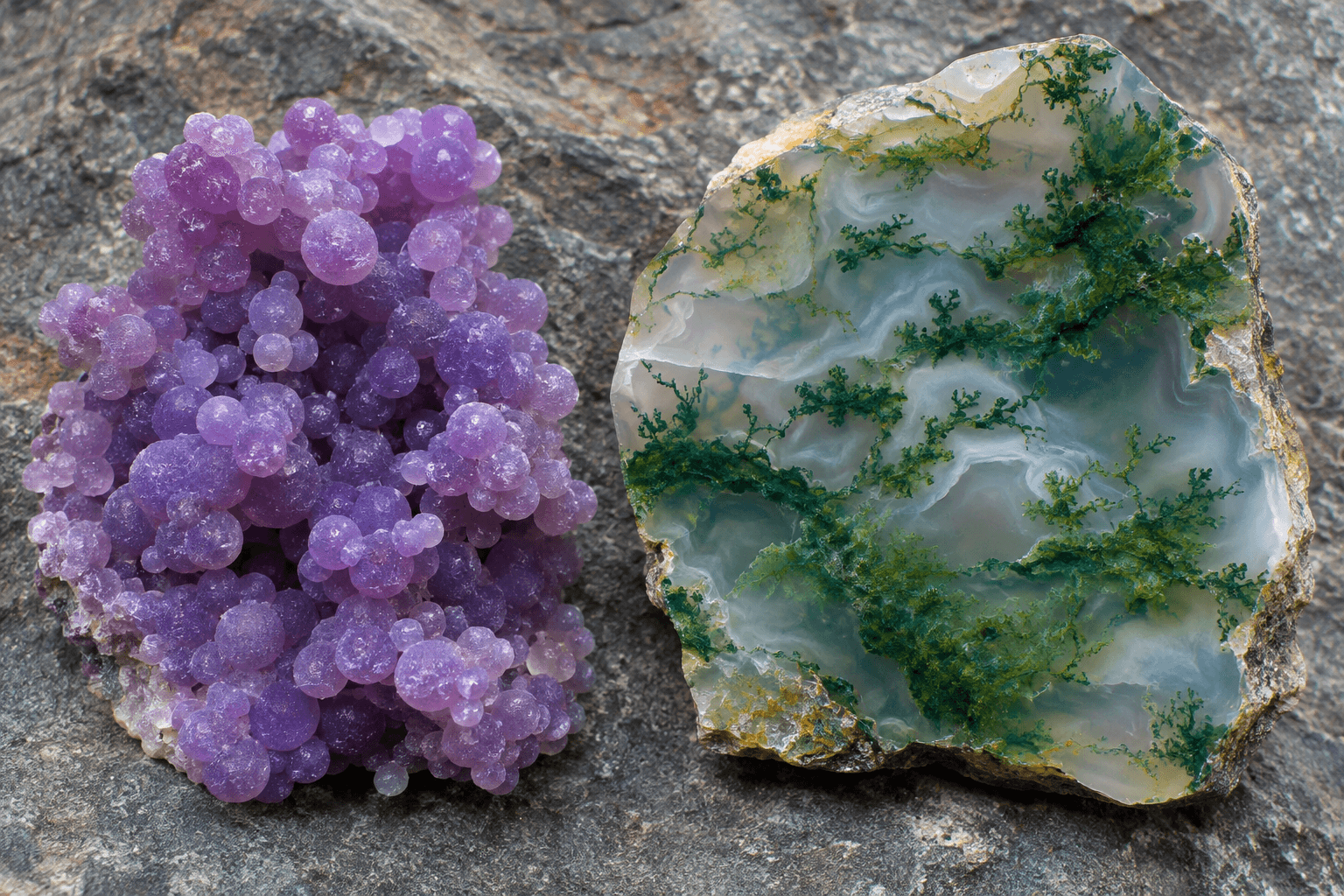
Manakarra grape agate is a botryoidal variety of chalcedony found in West Sulawesi, Indonesia. The name describes its most famous habit: rounded, grape-like clusters of microcrystalline quartz that grow inside cavities and geodes. Color ranges from pale lavender and deep purple to sage green, blue-gray, and white. The botryoids are often hollow-centered or lined with tiny quartz crystals, which is why a cut slice can look like a cluster of bubbles.
Mineralogically, grape agate is chalcedony (SiO2), the same family as agate and jasper, with a Mohs hardness of about 6.5-7 and a specific gravity near 2.6. It is not a separate mineral species, and "grape agate" is a trade name rather than a scientific term. The finest pieces show uniform, well-formed botryoids with strong color saturation and clean, fracture-free surfaces. According to gemmological references such as GIA and Gem-A, chalcedony's toughness and fine grain make it ideal for cabochons and carved forms.
What Is Java Moss Agate and Dendritic Agate?
Java moss agate is also chalcedony, but its beauty comes from inclusions rather than from the host silica. Thin filaments of chlorite, iron oxide, and manganese oxide are trapped during growth, creating green, brown, or black "moss" and "dendrite" patterns that resemble miniature landscapes. The host is usually translucent to semi-opaque, which gives the inclusions depth and contrast.
Unlike true agate, moss agate does not show concentric banding; the name is traditional. Hardness is the same 6.5-7 Mohs, so it cuts and polishes similarly to grape agate. Java and Central Java localities are known for vivid green moss patterns, while other Indonesian sources produce dendritic agate with more angular, tree-like inclusions. Collectors often slab moss agate to display the full "scene," or cut high-domed cabochons that magnify the pattern.
Side-by-Side Comparison
Appearance and Pattern
Grape agate is three-dimensional: you are looking at rounded botryoids, cavities, and crystal linings. Moss agate is essentially two-dimensional: the pattern lies inside a translucent window. Grape agate rewards viewing from multiple angles; moss agate rewards a single, well-chosen orientation.
Mineralogy and Hardness
Both are chalcedony (microcrystalline quartz), so both sit at 6.5-7 on the Mohs scale and share a similar specific gravity near 2.6. Neither requires special tools beyond standard lapidary equipment. The difference is not hardness but structure: grape agate can have hollow centers and thin walls, while moss agate is usually solid.
Formation and Locality
Manakarra grape agate forms in volcanic cavities in West Sulawesi, where silica-rich fluids deposit layer after layer of chalcedony. Java moss and dendritic agate form in fractures and vesicles in volcanic host rocks, where mineral-laden water deposits both silica and coloring oxides. Both localities sit within Indonesia's volcanic belt, but the exact chemistry and cooling history produce very different textures.
Cutting and Jewelry Use
Grape agate is most often sold as freeform cabochons, geode slices, or display specimens; hollow botryoids require careful backing or stabilization. Moss agate is a classic cabochon and slab material, often cut to frame a "landscape." For mixed-hardness stones, both behave predictably, though grape agate's thin walls need gentler pressure.
Value and Collectibility
Value in grape agate depends on color saturation, uniformity of botryoids, cavity quality, and absence of fractures. Value in moss agate depends on pattern clarity, color contrast, and translucency. Neither is typically heat-treated or dyed in high-quality material, so untreated, well-documented specimens command a premium.
How to Identify Genuine Indonesian Specimens
- Check for natural variation: no two botryoids or dendrites are identical.
- Avoid unnaturally vivid, uniform color, which may indicate dye.
- Look for mineral inclusions consistent with locality, such as chlorite in moss agate.
- Request locality documentation; provenance increases value.
- Consult gemmological labs such as GIA or Gem-A for high-value pieces.
Care and Storage
Both stones are durable, but avoid sudden temperature changes and sharp impacts, especially on thin grape agate walls. Clean with mild soap and water, and avoid harsh chemicals. Store pieces separately to prevent scratching. For geode slices, support the back to prevent stress on hollow botryoids.
Where to Start Your Collection
Browse our natural stone catalog for Indonesian chalcedony, explore cabochons for jewelry-ready stones, or choose rough material for lapidary projects. Need custom cutting? See our lapidary services. For display pieces, visit specimens.
Frequently Asked Questions
Is grape agate a real mineral?
No. Grape agate is a trade name for botryoidal chalcedony, a microcrystalline quartz. It is not a separate mineral species.
Is moss agate actually agate?
Strictly speaking, no. Moss agate lacks the banding of true agate; it is chalcedony with dendritic inclusions. The name is traditional.
Which is better for cabochons?
Moss agate is generally easier for classic cabochons because it is solid and translucent. Grape agate excels as freeform cabochons and display slices.
How do I know if a stone is dyed?
Look for color concentrated along fractures or unnaturally uniform hues. Untreated stones show natural variation and inclusions.
Sources: GIA, Gem-A, mindat.org, USGS.