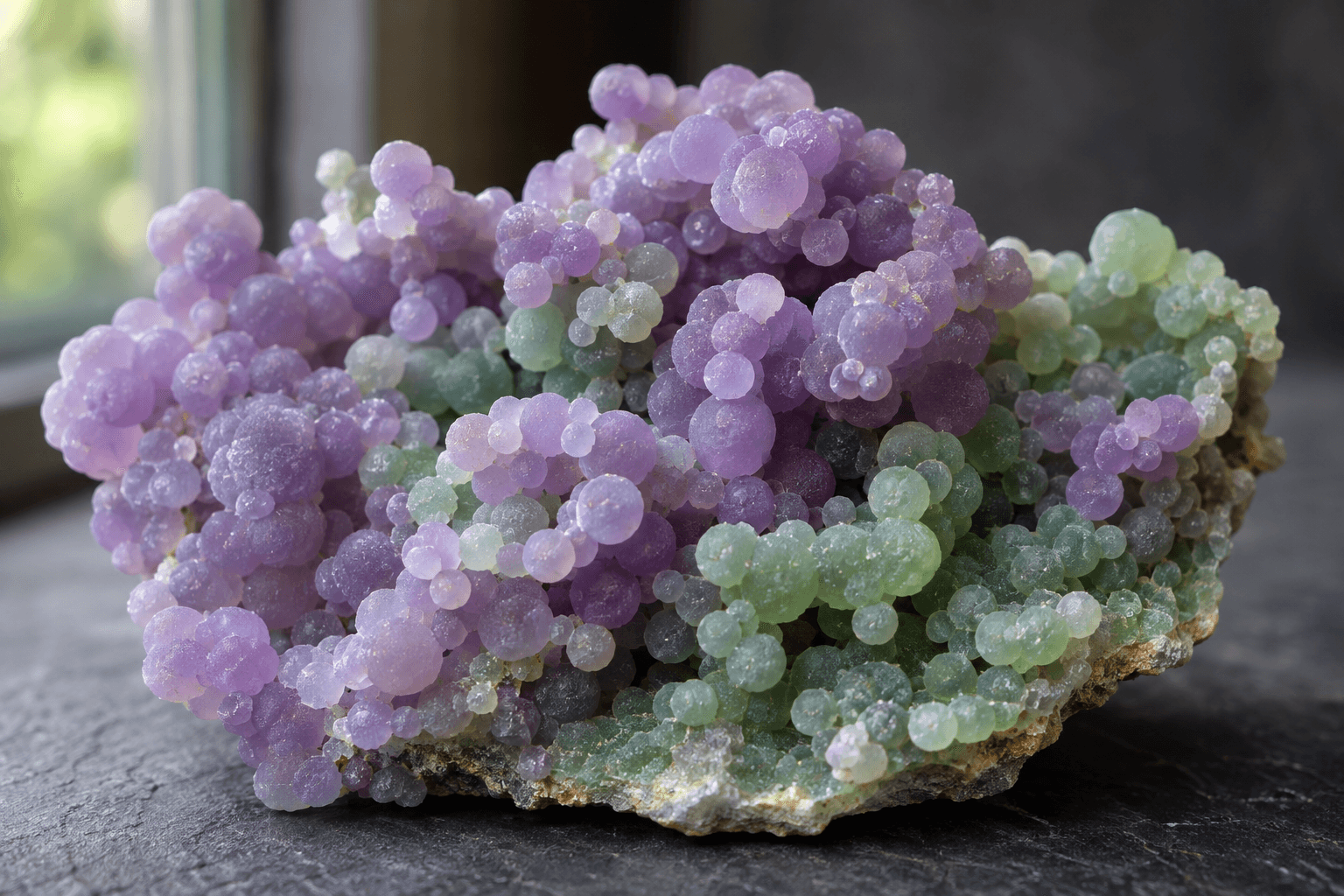
Manakarra grape agate is one of Indonesia's most recognizable mineral discoveries: a botryoidal (grape-like) cluster of silica from the Manakarra district of West Sulawesi. Collectors often call it 'grape agate,' but mineralogically it is not true agate because it lacks banding. Published mineralogical work describes the purple material as amethystine quartz rather than true chalcedony. For buyers, the practical question is how a specimen performs visually: color saturation, sphere definition, luster, size, and condition.
What Makes Manakarra Grape Agate Different
Grape agate forms in voids within Miocene andesite pillow lava. Silica-rich fluids precipitated radial spherulites of quartz, commonly 3-6 mm across in typical collector material, with reported examples reaching roughly 2-20 mm. The result is a cluster of rounded 'grapes' that can be lavender, lilac, deep purple, gray, or pastel green. Purple is the color most buyers expect, but green and bicolor pieces are rarer and often collected as curiosities.
Mineralogical data commonly cited for the material include:
- Composition: SiO2 (quartz), with minor potassium, aluminum, calcium, and magnesium derived from host rock.
- Hardness: Mohs 7
- Specific gravity: 2.65-2.66
- Crystal habit: botryoidal, radial spherulites
- Luster: dull to vitreous; drusy sparkle on sphere surfaces in better pieces
Because the spheres are brittle, damage is visually loud. A single chipped front sphere can dominate the appearance of an otherwise fine cluster.
A Practical Grading Framework for Collectors
There is no universal grading standard for grape agate comparable to diamond grading. Dealers and collectors instead weigh five factors: color, form, luster, size, and condition. The framework below is a buying tool, not an official certificate.
1. Color Saturation and Distribution
Deep, even purple is the most sought-after color in the trade. Lilac and lavender are common and attractive when the cluster is clean. Pastel green is rare and collected for its unusual chemistry. Gray or off-white material near surface zones is usually less valuable unless it has exceptional form.
Look for color that is consistent across the front of the cluster. Patchy color, muddy brownish tones, or color concentrated only on broken surfaces can signal lower grade - or, in extreme cases, dye. Natural color often shows subtle variation inside individual spheres; suspiciously uniform color on a dull matrix deserves closer inspection.
2. Botryoidal Form and Sphere Definition
Well-separated, rounded spheres create the strongest 'grape' effect. Three-dimensional clusters with natural negative space are more prized than flat botryoidal crusts. Top pieces show tight, even spheres with crisp boundaries; lower-grade material can look lumpy, fused, or flattened.
Sphere size matters, but definition matters more. A compact cluster of 4 mm spheres with clean separation can outgrade a larger mass of fused 8 mm spheres.
3. Luster and Drusy Sparkle
Luster ranges from dull to vitreous. The best specimens have a bright, wet-looking shine, sometimes enhanced by drusy quartz sparkle on sphere surfaces. Sparkle adds depth and movement, especially under directed light. Dull, chalky, or waxy-looking surfaces usually indicate lower grade or weathered material.
4. Size and Three-Dimensional Presence
Size is a primary price factor, but only when form and color hold. Miniature specimens with saturated color and no damage are harder to find than many buyers assume. Large cabinet pieces with vivid color and intact spheres command a strong premium. Flat plates and broken fragments are common in exported material.
5. Condition and Damage
Damage is especially important in grape agate because the eye expects every grape to be complete. Chips on front spheres, bruised edges, and broken contacts are more visually distracting than on conventional crystal specimens. Inspect under raking light and magnification before purchase.
Common Treatments and Red Flags
Grape agate is usually sold untreated, but strong demand for deep purple has encouraged abuse. Watch for:
- Dye: unnaturally uniform purple, color pooling in fractures, or purple that rubs onto a cotton swab.
- Resin stabilization: glossy, plastic-like surface, filled pits, or a warm feel.
- Heat or bleaching: uneven color loss or chalky surfaces.
- Composite repairs: glued spheres or matrix additions.
Natural specimens may still have color variation, minor matrix, and surface irregularity. Those are not defects; they are evidence of natural growth.
Buying Tips for US Collectors and Lapidaries
- Buy from sellers who state locality (Manakarra, West Sulawesi) and provide close-up photos.
- Ask whether the specimen is natural, untreated, and repaired.
- Compare color under daylight and warm LED; purple can shift.
- For cabochon or slab work, inspect for fractures and voids; botryoidal clusters can be brittle.
- Store dry and padded; avoid hard knocks that chip spheres.
- For display, use a stable base and keep away from vibration and dust.
RENDI VIRGO sources Indonesian silica specimens and offers both display pieces and lapidary rough. Browse the main shop, specimen display minerals, and rough materials collections, or request custom cutting through lapidary services.
FAQ
Is grape agate a true agate?
No. Despite the trade name, grape agate lacks the banding that defines agate. It is a botryoidal silica mineral, and published mineralogical work identifies the purple material as amethystine quartz.
What color is most valuable?
Deep, saturated purple with even distribution is generally most sought after. Pastel green and bicolor pieces can be valuable for rarity, while gray or off-white material is usually less valuable unless form is exceptional.
How can I tell if grape agate is dyed?
Look for unnaturally uniform color, dye pooling in fractures, or color transfer to a cotton swab. Compare color variation inside individual spheres; natural material usually shows subtle internal variation.
Does grape agate make good cabochons?
It can, but the botryoidal spheres are brittle and may chip or undercut. Choose solid, fracture-free pieces and use gentle pressure. Many collectors prefer to keep fine clusters as display specimens.
For mineralogical data and locality records, consult mindat and published papers on Manakarra botryoidal quartz; for market context, compare reputable mineral dealers and recent auction listings.