
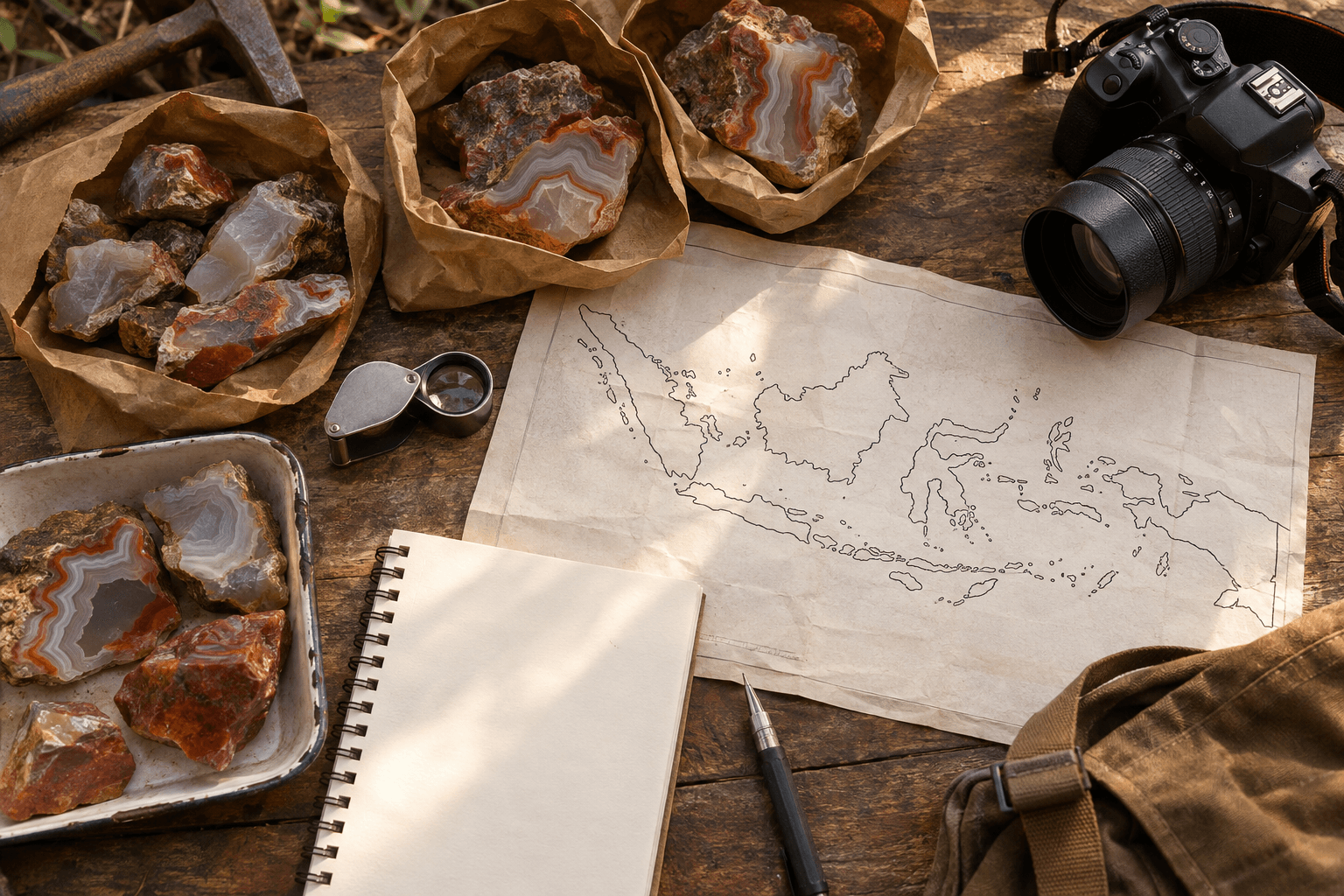
Provenance is the quiet force behind a gemstone's long-term value. Two stones can share the same color, clarity, and cut, yet the one with documented locality, acquisition history, and consistent chain of custody often commands a stronger price and a faster sale. For collectors of Indonesian natural stones, provenance is not a luxury reserved for museum pieces; it is the difference between a specimen with a story and an anonymous rock.
What Is Gemstone Provenance?
In gemmology, provenance is a documented claim about a stone's origin, source, previous ownership, or extraction and processing practices. The SSEF (Swiss Gemmological Institute) and Gem-A distinguish provenance from geographic origin: provenance is supported by records such as invoices, photographs, measurements, and supply-chain documents, while geographic origin is a scientific opinion reached by comparing a stone's physical and chemical properties with reference collections. In other words, provenance answers 'where was this documented to come from?' and origin determination answers 'what does the science suggest?'
This distinction matters because a country-of-origin report can support a locality claim, but it is rarely definitive proof on its own. Multiple deposits can produce stones with overlapping trace-element signatures, and some localities are geologically similar. Reliable provenance therefore depends on retaining information from the time of mining or first documented sale.
Why Locality Documentation Increases Value
Geographic origin has always influenced colored-stone value. A ruby from Mogok in Myanmar and a ruby from Mozambique may both be fine gems, but the market often assigns different premiums because of history, scarcity, and narrative. GIA's field gemology department was created in 2008 precisely to build reference databases from stones collected as close to the source as possible, with careful documentation of how, when, where, and from whom they were acquired. That work exists because locality is now treated as a value factor comparable to color, size, and shape.
For collectors, documentation builds confidence. A stone accompanied by consistent records is easier to insure, easier to resell, and easier to defend against misrepresentation. For Indonesian material, locality can also highlight rarity: Manakarra Grape Agate from West Sulawesi, Banten Kalimaya opal, or Garut petrified wood each carry a regional identity that generic labels cannot replace.
Provenance vs. Geographic Origin: Know the Difference
- Provenance (documented): invoices, dealer notes, mine or region names, dates, photographs, weights, dimensions, and chain-of-custody records.
- Geographic origin (scientific): a laboratory opinion based on microscopy, spectroscopy, and chemistry compared with known reference samples.
- Traceability (supply chain): tracking an item from origin to consumer using records or tagging technology.
- Tracking (records-based): using documents to follow an item through the supply chain.
A country-of-origin report supports a claim; it does not stand alone as proof. The most defensible collections combine both: clean paperwork plus, where budget allows, an independent laboratory report.
How to Document Locality for Your Collection
Start a simple provenance file for every specimen. Include:
- Purchase record: seller name, date, price, and payment reference.
- Locality statement: country, region, district, and mine or deposit name if known.
- Physical data: weight, dimensions, and a clear photo set (top, side, bottom, and any distinguishing features).
- Condition notes: treatments, repairs, or stabilization disclosed at purchase.
- Chain of custody: every transfer between owners, with dates.
- Storage and care: environment, labels, and container references.
Consistency matters more than complexity. A spreadsheet with the same fields for every stone is more valuable than scattered notes. When you photograph a specimen, include a scale and a label showing the locality and date; this creates a time-stamped visual record that is hard to dispute later.
Provenance for Indonesian Natural Stones
Indonesia's gem wealth is regionally diverse: botryoidal chalcedony from Manakarra in West Sulawesi, moss and dendritic agate from West and Central Java, blue amber from Sumatra, chrysocolla in chalcedony from Halmahera, agatized coral from West Java, petrified palm wood from Garut, picture jasper from Sukabumi, and hydrophane opal from Banten. Many of these materials come from artisanal or small-scale mining, where formal mine identifiers and export paperwork may be limited.
That reality makes buyer-side documentation essential. Record the dealer or workshop, the stated region, the purchase date, and the stone's physical traits. If a seller provides a locality certificate or batch photo, store it with the specimen. For higher-value pieces, consider an independent gemological report that states the country of origin as a scientific opinion, then keep the paperwork and report together.
What to Ask Before You Buy
- What is the stated country and region of origin?
- Is the locality based on documentation, science, or seller tradition?
- Has the stone been treated, stabilized, or dyed?
- Are there photos of the rough or the mining area?
- What records will transfer with the stone?
- Will the seller state the locality in writing on the invoice?
Common Pitfalls and Red Flags
- Vague labels such as 'from Indonesia' with no region.
- Stories that change between listings or conversations.
- Missing weight or dimensions on high-value stones.
- Certificates that confuse provenance with origin determination.
- Prices far below market for 'rare locality' material.
- Refusal to put locality claims in writing.
FAQ
What is gemstone provenance?
Gemstone provenance is the documented history of a stone's origin, source, ownership, and handling. It relies on records rather than scientific testing alone.
Is a country-of-origin report the same as provenance?
No. A country-of-origin report is a scientific opinion based on physical and chemical properties. Provenance is a documented claim supported by invoices, photographs, and supply-chain records.
Does provenance guarantee higher resale value?
No guarantee, but consistent documentation usually improves buyer confidence, insurability, and resale speed, especially for rare or locality-specific stones.
How do I document a stone with no paperwork?
Record seller details, stated locality, date, price, weight, dimensions, and a dated photo set. Keep all future transfers documented to build a chain of custody.
Explore our natural stone catalog, cabochon collection, rough materials, and display specimens, or learn about our custom lapidary services.