
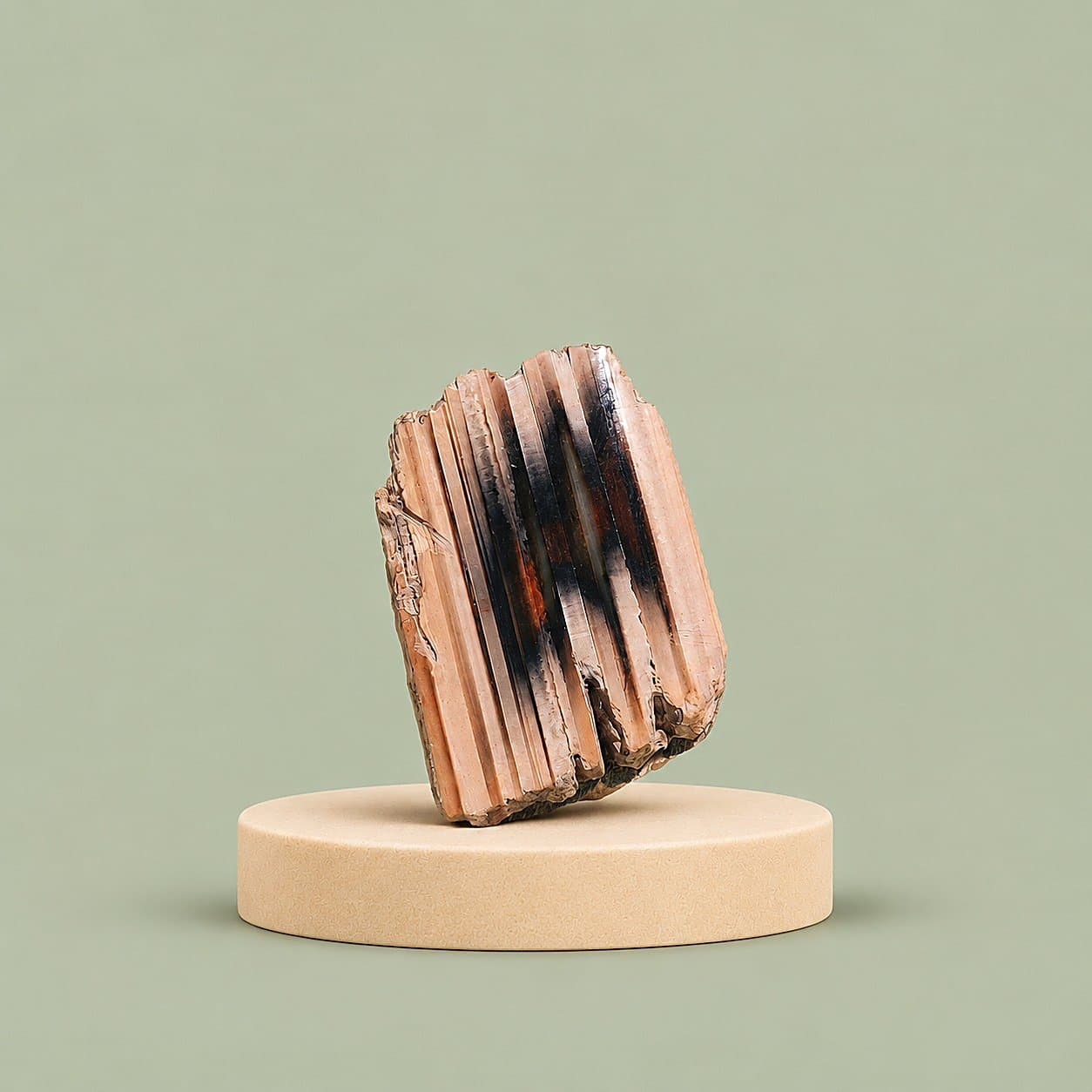
Sukabumi Picture Jasper and Landscape Agate from West Java, Indonesia, are among the most evocative chalcedonies in the archipelago. These stones do not merely display color — they hold entire landscapes within a hand-sized cabochon. Rolling hills, distant mountain ridges, drifting clouds, and river valleys appear in microscopic detail, rendered by nature in iron, manganese, and clay minerals suspended in a quartz matrix. For lapidaries, collectors, and jewelry designers, these materials offer a rare convergence: the hardness and polish of chalcedony (Mohs 6.5–7) paired with unrepeatable scenic imagery formed entirely by geological processes.
The trade names "picture jasper" and "landscape agate" describe visual habit, not separate mineral species. Both are chalcedony — microcrystalline quartz — whose transparency allows internal features to be read like a topographic map. In the Sukabumi material, the host chalcedony ranges from colorless to milky white, sometimes with a warm cream or pale gray cast, providing a neutral canvas for the mineral paintings within.
Geological Setting: West Java's Volcanic Canvas
Sukabumi sits on the southern flank of West Java's volcanic arc, where Tertiary to Quaternary volcanism deposited thick sequences of tuffs, breccias, and lava flows. Hydrothermal silica circulated through fracture networks, vugs, and porous volcaniclastics, precipitating as chalcedony linings and fillings. Where those fluids carried dissolved iron oxides (hematite, goethite), manganese oxides, and clay minerals (smectite, kaolinite), the growing chalcedony trapped them as dendritic, plume, and stratified inclusions.
The resulting patterns are not random. They record paleo-flow directions, redox fronts, and episodic fluid pulses — each band, plume, and dendrite a timestamp in the stone's growth history. The Geological Survey of Indonesia maps the Sukabumi region as dominated by the Cikarang and Bojongmanik formations, volcaniclastic units known for chalcedony and agate occurrences in their upper members.
How the Landscapes Form: Stratigraphy in Miniature
Three inclusion styles create the scenic effect:
- Stratified Iron-Oxide Banding — Horizontal to sub-horizontal layers of hematite and goethite mimic sedimentary bedding planes. When cut parallel to bedding, these read as distant hill ridges receding into haze.
- Plume and Dendritic Manganese Oxides — Feathery, tree-like growths of manganite, pyrolusite, and hollandite branch through the chalcedony, resembling vegetation on slopes or clouds above peaks.
- Clay-Mineral Haze Zones — Fine-grained smectite and kaolinite suspensions create soft, diffuse zones that read as atmospheric perspective — mist in valleys, cloud banks over ridges.
A single cabochon often combines all three: a dark basal band (foreground), a plume field (mid-ground vegetation), a pale clay haze (atmosphere), and a clear chalcedony cap (sky). The lapidary's task is to orient the slab so these layers align with the dome's optical axis.
Identifying Sukabumi Picture Jasper vs. Landscape Agate
The distinction is subtle and often blurred:
| Feature | Picture Jasper | Landscape Agate |
|---------|----------------|-----------------|
| Pattern Style | Discrete, high-contrast "scenes" with clear foreground/mid-ground/background | Softer, more diffuse panoramic vistas |
| Dominant Inclusions | Iron-oxide banding (red-brown to black) | Manganese dendrites + clay haze (gray-blue to sepia) |
| Host Chalcedony | Often more opaque, cream to tan | Typically more translucent, colorless to pale gray |
| Cutting Preference | Slab parallel to banding for "horizon" effect | Slab perpendicular to dendrites for "depth" effect |
In practice, Sukabumi material spans a continuum. A single nodule may yield both picture jasper slabs (cut parallel to banding) and landscape agate slabs (cut across dendritic growth). Dealers often sort by visual effect rather than strict taxonomy.
Market Grading: What Drives Value
Grading follows a hierarchy familiar to scenic-stone collectors:
- Composition & Narrative — Does the stone "read" as a coherent landscape? A clear horizon line, balanced foreground-to-background ratio, and recognizable landforms (peaks, valleys, water bodies) command premium prices.
- Color Harmony — Warm earth tones (sienna, ochre, umber) with cool accents (slate blue, mist gray) are most sought after. Monochrome stones or garish color clashes grade lower.
- Contrast & Depth — Sharp delineation between elements creates three-dimensionality. Muddy, low-contrast material reads flat.
- Translucency & Polish — High translucency allows light penetration, illuminating internal scenes. A glassy, pit-free polish is mandatory for top grades.
- Size & Freedom from Fractures — Large, intact slabs (>100 mm) without healed fractures or vugs are exponentially rarer.
Top-grade Sukabumi picture jasper cabochons (25–40 mm) regularly sell in the US$80–250 range at Tucson and Munich shows, with exceptional scenic pieces exceeding US$500. Rough slabs trade at US$15–40 per gram depending on grade.
Cutting & Orientation for Maximum Effect
Orientation decides whether a stone becomes a masterpiece or a muddle:
- Picture Jasper: Saw the nodule to expose a flat face parallel to the dominant iron-oxide banding. Slab thickness 4–6 mm for standard cabochons; 8–10 mm for high domes that magnify depth. Trim the preform to center the most compelling "scene" under the dome apex.
- Landscape Agate: Saw perpendicular to the primary dendritic growth direction so plumes radiate toward the dome crown. This creates a "forest rising to sky" effect when domed.
- Dome Height: High domes (height-to-width ratio 0.6–0.7) act as magnifying lenses, expanding the apparent depth of the scene. Low domes (0.3–0.4) preserve a flatter, map-like view. Match dome to pattern: high for dendritic depth, medium for stratified banding.
- Backing: Dark backing (black epoxy or onyx) intensifies contrast in translucent material. Transparent backing preserves the stone's natural glow for backlit display.
The GIA Gem Encyclopedia notes that chalcedony's refractive index (1.544–1.553) and critical angle (~40°) mean dome geometry directly controls internal light paths — the same optics that govern cat's-eye and star stones apply to scenic chalcedony.
Care & Durability
Sukabumi chalcedony is durable (Mohs 6.5–7) and stable. No special care beyond standard chalcedony protocols:
- Clean with warm water, mild soap, and a soft brush. Avoid ultrasonic if fractures are present.
- Store separately from harder stones (corundum, diamond, topaz) to prevent scratching.
- No known sensitivity to light, heat, or common chemicals. The iron and manganese oxides are fully oxidized and stable.
- Not a hydrophane material — no crazing risk like opal.
Internal Links to RENDI VIRGO Collections
Explore Sukabumi and related Indonesian chalcedonies in our shop:
- Cabochons Collection — Finished Sukabumi picture jasper and landscape agate cabochons, ready for setting.
- Rough Materials — Slabs and preforms for lapidaries who want to cut their own scenes.
- Specimen Minerals — Unpolished nodules showing natural botryoidal and geode forms.
Pertanyaan? (FAQ)
Apakah Sukabumi Picture Jasper agate sejati?
Secara mineralogi, keduanya adalah kalsedon (kuarsa mikrokristalin). Nama "jasper" merujuk pada ketidak-tembus-pandangan dan warna bumi yang didominasi oksida besi; "agate" merujuk pada tembus pandang dan pola dendritik. Sukabumi menghasilkan keduanya dari sistem hidrotermal yang sama.
Mengapa disebut "Picture" dan "Landscape"?
Karena inklusi alami (oksida besi, oksida mangan, mineral lempung) membentuk pola yang menyerupai pemandangan: bukit, awan, lembah, garis horizon — bukan sekadar warna acak.
Bagaimana cara memilih slab yang baik untuk dipotong?
Cari: (1) garis horizon jelas atau komposisi pemandangan seimbang, (2) kontras warna hangat-dingin yang harmonis, (3) kalsedon cukup tembus pandang untuk kedalaman optik, (4) bebas retak dan rongga besar di area citra utama.
Apakah batu ini dirawat (treated)?
Material RENDI VIRGO alami 100%, tanpa pewarna (dye), stabilisasi resin, atau pemanasan. Warna dan pola sepenuhnya geologis.
Di mana lokasi pastinya?
Kecamatan dan Kabupaten Sukabumi, Provinsi Jawa Barat, Indonesia — di kaki pegunungan vulkanik selatan Jawa.