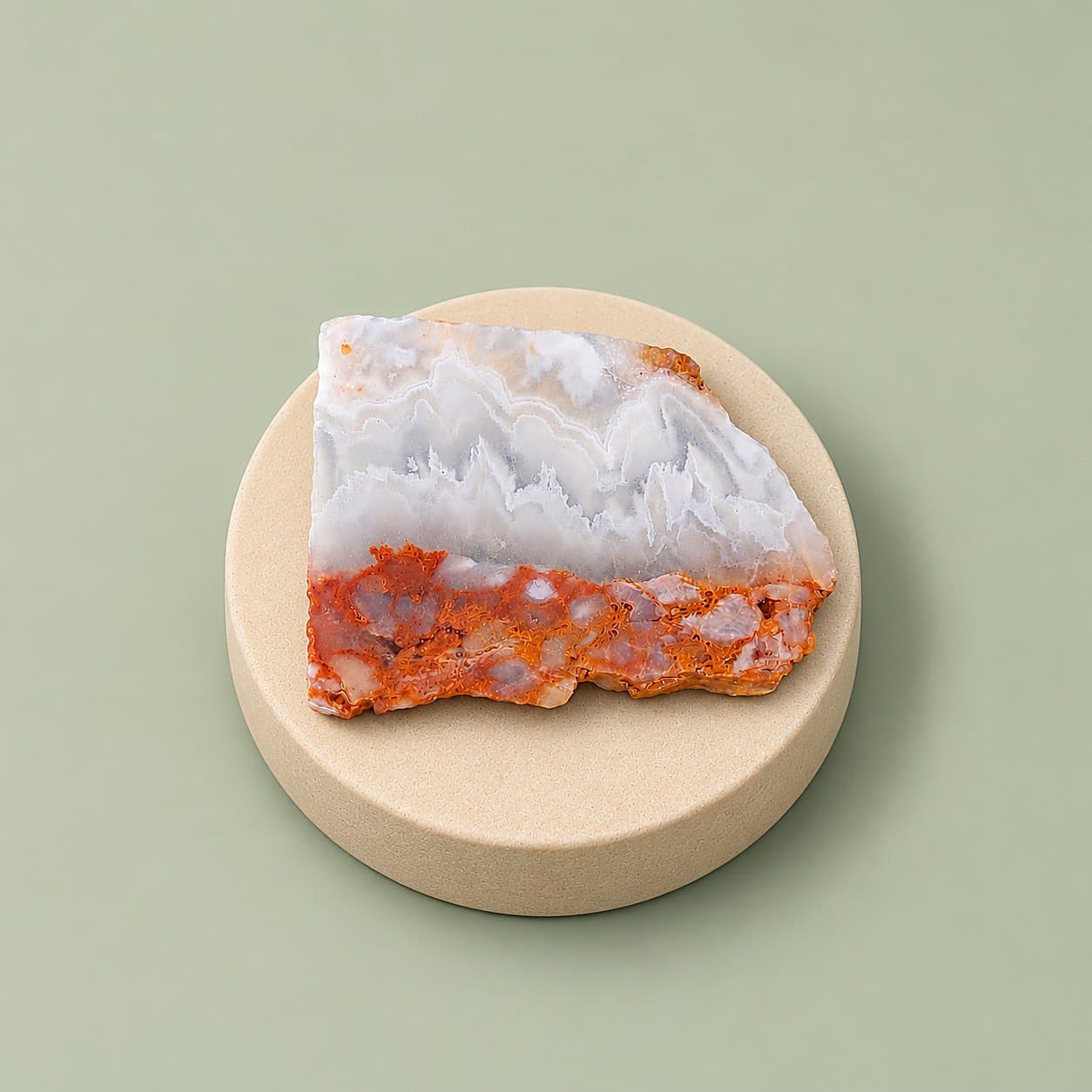
Java Moss Agate and Dendritic Agate from West and Central Java are among the most visually arresting chalcedonies in the Indonesian archipelago. These stones do not merely display color — they preserve miniature landscapes inside a translucent quartz matrix. Filaments of chlorite, manganese, and iron oxides branch like ancient ferns, settle like moss on a forest floor, or feather into dendritic trees that span the entire cabochon. For lapidaries, collectors, and jewelry designers, these materials offer a rare combination: the hardness and polish of chalcedony (Mohs 6.5–7) paired with organic, unrepeatable imagery that forms entirely through natural geological processes.
The trade names "moss agate" and "dendritic agate" describe inclusion habit, not separate mineral species. Both are chalcedony — microcrystalline quartz — whose transparency allows internal features to be read like pages in a book. In the Indonesian material, the host chalcedony is typically colorless to milky white, sometimes with a faint bluish or gray cast, providing a neutral stage for the mineral paintings within.
Geological Setting: Volcanic Java and Hydrothermal Silica
Java sits on the Sunda Arc, a volcanic chain formed by the subduction of the Indo-Australian Plate beneath the Eurasian Plate. This tectonic regime produces calc-alkaline volcanism, abundant hydrothermal circulation, and pervasive silica mobility — the essential ingredients for chalcedony formation.
In West Java (Jawa Barat) and Central Java (Jawa Tengah), Tertiary to Quaternary volcaniclastics — tuffs, breccias, and lavas — host countless vugs, fractures, and fault zones. As hydrothermal fluids cooled, silica precipitated as chalcedony linings and fillings. Where those fluids carried dissolved transition metals (iron, manganese) and magnesium-iron silicates (chlorite group), the growing chalcedony trapped them as inclusions. The result: moss agate (chlorite-dominated, green to brown filaments) and dendritic agate (manganese/iron oxide-dominated, black to brown branching trees).
Key localities include the volcanic slopes around Bandung, Garut, Tasikmalaya, and Ciamis in West Java, and the Purworejo–Kebumen area in Central Java. Exact source mapping remains informal; much material enters the market through Lapidary networks in Bandung and Jakarta without precise GPS coordinates. This is a gap the trade is gradually closing — see the Provenance section below.
How the Inclusions Form: Two Distinct Habits
Moss Agate: Chlorite Filaments
Moss agate inclusions are typically chlorite-group minerals (clinochlore, chamosite, penninite) — sheet silicates that crystallize as fine, hair-like to mossy aggregates. In transmitted light they read green (iron-rich chlorite) to brownish-green (magnesium-rich). The filaments grow in three dimensions, suspended in the silica gel before it fully crystallizes to chalcedony. When the cabochon is cut, the section plane reveals cross-sections of these 3D forests — sometimes as dense mats, sometimes as isolated sprays.
Chlorite stability requires mildly alkaline, low-temperature (100–200 °C), silica-saturated fluids — exactly the conditions in Java's shallow hydrothermal systems. The chlorite likely nucleated on fracture walls or gas-bubble surfaces, then grew inward as the gel solidified.
Dendritic Agate: Manganese & Iron Oxide Trees
Dendritic patterns are not plant fossils. They are inorganic crystal growths — manganese oxides (pyrolusite, hollandite, romanechite) and iron oxides (goethite, hematite) — that branch along diffusion fronts in the silica gel. The classic "tree" morphology arises from diffusion-limited aggregation: ions migrate toward a growing tip, the tip advances, and side branches form where the concentration field permits. Each dendritic aggregate is a frozen snapshot of a non-equilibrium growth process.
In Indonesian material, dendrites are typically black (Mn-oxides) to reddish-brown (Fe-oxides). They often coexist with chlorite moss in the same nodule, producing composite scenes where green "undergrowth" meets black "canopy."
Reading the Stone: What Collectors and Cutters Look For
Pattern Clarity and Contrast
The best moss and dendritic agates show high contrast between inclusion and host. A colorless, inclusion-free chalcedony matrix makes the filaments pop. Milky or heavily fractured matrix reduces legibility. Collectors grade by:
- Contrast: Sharp, dark dendrites on water-clear ground > faint gray dendrites on cloudy ground.
- Completeness: Full, unbroken trees or moss sprays > fragmented snippets.
- Composition: Balanced, aesthetically arranged scenes > random clutter.
- Depth: Inclusions visible at multiple depths (readable through the dome) > surface-only features.
Orientation for Cutting
Because inclusions are 3D, slab orientation decides what the finished cabochon reveals.
- Parallel to bedding/fracture planes: Often yields the longest, most continuous dendrite or moss "panels."
- Perpendicular: Cross-cuts filaments into dots and short segments — usually less desirable.
- Dome height: A higher dome (height-to-width ratio 0.6–0.7) acts as a magnifying lens, enlarging the apparent scene and improving light return through the inclusions. See our Cabochon Dome Geometry guide for ratios.
Lapidaries working Indonesian moss/dendritic agate should slab first, wet the surface, and rotate under strong directional light before committing to a cabochon outline. The "picture" often shifts dramatically with a few degrees of tilt.
Grading & Market Terminology
No universal grading standard exists for moss/dendritic agate. The trade uses descriptive tiers:
| Tier | Description | Typical Use |
|------|-------------|-------------|
| AAA / Collector Grade | Water-clear matrix, high-contrast complete scenes, multiple depths, no fractures | High-end cabochons, specimen slabs, investment pieces |
| AA / Jewelry Grade | Clear to slightly milky matrix, strong patterns, minor fractures acceptable | Standard cabochons for rings, pendants, beads |
| A / Commercial | Milky matrix, moderate contrast, visible fractures or cloud zones | Beads, carvings, entry-level jewelry |
| B / Rough / Slab | Uncut or slabbed, sold by weight for cutter selection | Lapidary rough, wholesale |
Pricing (2024–2025 wholesale indicative, USD):
- AAA slabs (10×15 cm, 5–8 mm thick): $80–$250+
- AA cabochons (calibrated 10×14 mm oval): $15–$40
- A calibrated cabs: $5–$15
- Rough by kg (mine-run): $10–$30/kg
Indonesian material generally trades at a discount to classic Montana (USA) or Indian moss agate due to less established provenance documentation — an opportunity for dealers who invest in locality tracking.
Provenance & Locality Tracking: Why It Matters
Provenance — documented geographic origin down to the specific deposit or even pit — transforms a pretty stone into a data-rich specimen. For Indonesian moss/dendritic agate, provenance is currently weak. Most material is labeled only "Java" or "West Java." This hurts valuation and enables misrepresentation (e.g., selling treated or synthetic dendritic agate as natural Indonesian).
What proper provenance records should include:
- GPS coordinates (or at minimum desa/kecamatan/kabupaten)
- Host rock description (tuff, breccia, lava flow unit)
- Associated minerals (zeolites, calcite, opal, etc.)
- Collection date and method (artisanal mining, surface float, etc.)
- Chain of custody from miner to exporter
RENDI VIRGO is building a locality database for all Indonesian stones we sell. When you buy from our rough materials collection or cabochons, ask for the provenance sheet — we include it for every stone where data exists.
Practical Lapidary Notes
Hardness & Polish
Chalcedony Mohs 6.5–7 takes a superb polish with cerium oxide on leather, felt, or synthetic lap. Diamond compounds (50k → 14k → 3k → 1k) work faster but cost more. Polish quality directly affects inclusion visibility — a sub-par polish scatters light and hides the scene.
Fracture Management
Indonesian chalcedony often contains micro-fractures from volcanic stress and rapid cooling. Inspect slabs under 10× loupe with strong backlighting. Stabilization (resin impregnation under vacuum) is common in the trade for fractured material. Disclose it. Unstabilized, fracture-free material commands a premium.
Cutting Mixed Hardness Zones
Occasionally, moss agate nodules include harder quartz druze pockets or softer clay-filled vugs. Treat these as mixed-hardness stones: cut the bulk shape on a 220/280 grit, then switch to finer grits and lighter pressure for transition zones. See our guide on Cutting Mixed-Hardness Stones (forthcoming).
Safety
Chalcedony dust is silica — use wet cutting, ventilation, and a N95/FFP2 respirator. Manganese oxide dendrites are not hazardous in solid stone but avoid inhaling dust from heavily dendritic slabs.
Care & Durability
- Hardness 6.5–7: Suitable for daily-wear rings (protective bezel recommended), pendants, earrings.
- No cleavage: Conchoidal fracture only — chipping risk is low with proper bezel setting.
- Stability: Color and inclusions are light-stable. No fading under UV.
- Cleaning: Warm water, mild soap, soft brush. Ultrasonic safe for solid, unstabilized stones. Avoid steam (thermal shock risk on fractured pieces).
- Storage: Separate from harder gems (corundum, diamond, spinel) to prevent scratching.
Comparison: Indonesian vs. Other Global Sources
| Source | Typical Matrix | Inclusion Character | Market Position |
|--------|----------------|---------------------|-----------------|
| Java, Indonesia | Colorless to milky, often large nodules | Chlorite moss + Mn/Fe dendrites, often combined | Emerging, undervalued, high variety |
| Montana, USA | Transparent to translucent | Classic green chlorite moss, rarely dendritic | Benchmark for moss agate, premium pricing |
| India (Deccan Traps) | Milky to gray | Fine black dendrites, occasional moss | High volume, consistent, moderate price |
| Brazil (Rio Grande do Sul) | Clear to smoky | Strong dendrites, occasional plumes | Well-established, good provenance |
| Australia (Queensland) | Clear | Distinctive "plume" agate (Fe-oxide) | Niche, collector-focused |
Indonesian material's competitive edge: co-occurrence of moss and dendrites in single stones, large nodule sizes (up to 30+ cm), and untapped deposit diversity across Java's volcanic centers.
FAQ
Is moss agate a true agate?
Technically no. Agate implies banded chalcedony. Moss and dendritic agates are inclusion chalcedonies — chalcedony with mineral inclusions but no concentric banding. The trade name persists because "moss chalcedony" never caught on.
Can moss/dendritic agate be faked?
Yes. Synthetic dendritic patterns can be produced by electrodeposition or chemical gardens in glass/epoxy. Dyed chalcedony with painted dendrites exists. Buy from dealers who provide provenance and allow loupe inspection. Natural dendrites show 3D depth and diffusion-limited branching; fakes are usually 2D surface features.
Does heat treatment enhance moss agate?
No standard heat treatment improves chlorite or Mn-oxide inclusions. Heat can oxidize Fe²⁺ to Fe³⁺ (darkening red-brown tones) but risks fracturing the stone. Assume natural color unless disclosed otherwise.
What is "plume agate" and how does it differ?
Plume agate features feathery, plume-like inclusions (often iron oxides or goethite) that resemble smoke or feathers rather than trees or moss. Indonesian material occasionally shows plume habits alongside dendrites — a continuum, not a sharp boundary.
Where can I buy Indonesian moss/dendritic agate?
- Rough slabs & calibrated cabochons: RENDI VIRGO Shop — we source directly from West/Central Java artisanal networks.
- Specimen-grade slabs: Mineral Specimens — select pieces with exceptional scenes.
- Custom cutting: Lapidary Services — send us your rough or choose from our inventory.
Conclusion
Java Moss Agate and Dendritic Agate are geological paintings — each stone a unique record of hydrothermal fluid chemistry, diffusion physics, and volcanic history written in silica and transition metals. For the collector, they offer affordable entry into world-class picture stones. For the lapidary, they reward careful orientation and polishing with scenes that never repeat. For the jewelry designer, they provide narrative gemstones that customers can literally read.
As Indonesian provenance systems mature, these stones will close the valuation gap with established sources. Early buyers who document locality data position themselves ahead of that curve. Explore our current inventory of moss and dendritic agate cabochons and rough slabs, or contact us for custom cutting projects.
References: Mindat chalcedony & chlorite entries; USGS volcanic geology of Java; GIA Gem Encyclopedia (chalcedony); Journal of Gemmology hydrothermal silica studies; Rock & Gem Magazine Indonesian agate profiles.