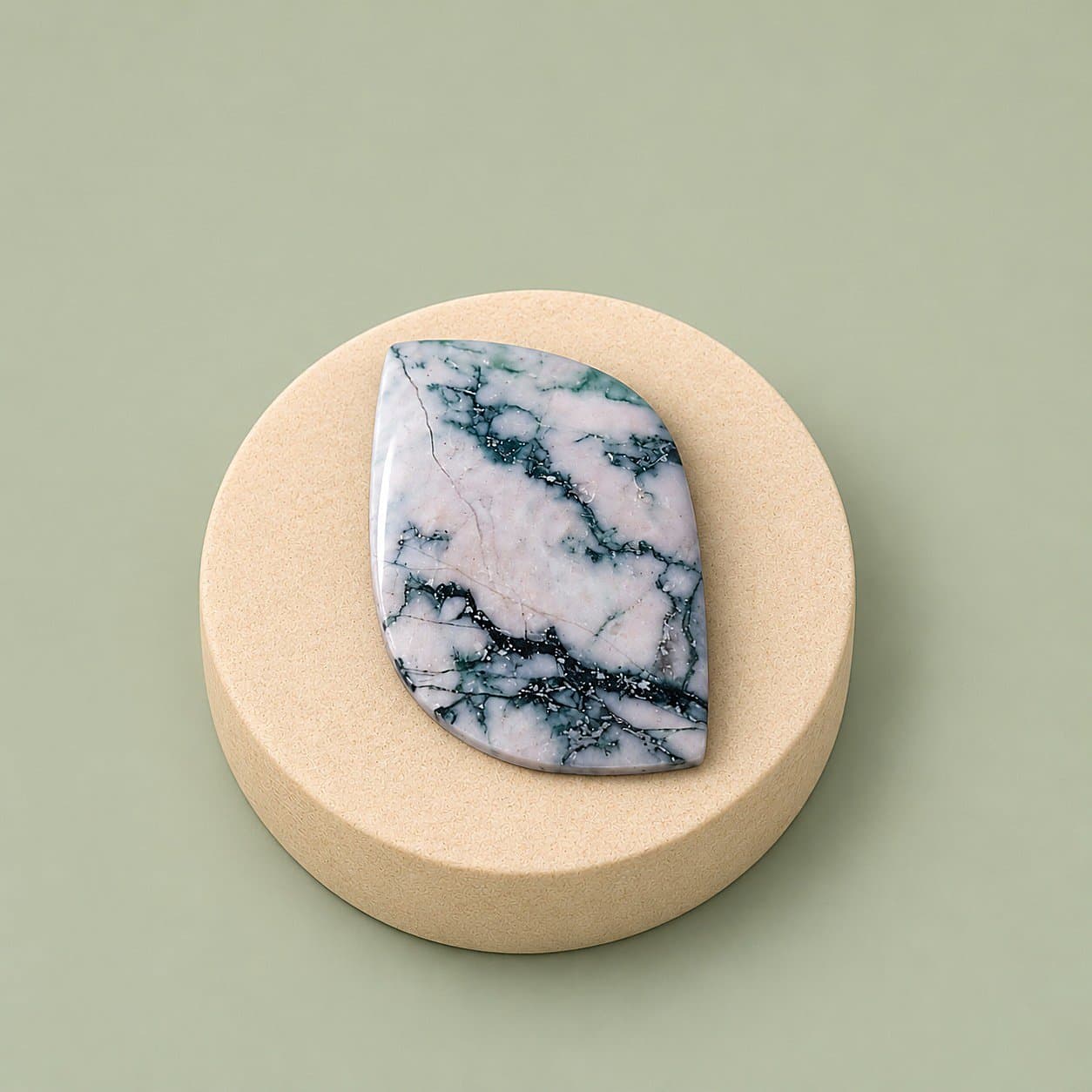
Halmahera chrysocolla in chalcedony — known internationally as gem silica — is the most celebrated blue-green gemstone to emerge from Indonesia's fabled Maluku Utara province. For decades, miners and collectors have treasured the vivid turquoise-to-teal chalcedony from the Bacan (Batjan), Doko, and Palamea localities on Halmahera and its satellite islands. Unlike common chrysocolla, which is a soft copper silicate (Mohs 2–4) that fractures easily, this material is chalcedony (microcrystalline quartz, Mohs 6.5–7) naturally impregnated with chrysocolla pigment. The result: a stone that carries the electric color of chrysocolla with the durability and polish of quartz.
This guide covers the geology, market grading, cutting orientation, identification, and care of Halmahera gem silica — the collector's blue-green standard from the Spice Islands.
Geological Setting: Volcanic Arcs and Copper-Rich Fluids
Halmahera sits on the Halmahera Arc, a young volcanic chain formed by the collision of the Philippine Sea Plate and the Eurasian Plate. This tectonic violence drives intense hydrothermal circulation. Copper-bearing fluids, leached from porphyry copper systems and volcanic-hosted massive sulfide deposits, migrated through fracture networks in andesitic to dacitic host rocks. Where those fluids met silica-saturated groundwater in vugs, faults, and breccia zones, they precipitated chalcedony — layer by layer — with chrysocolla coloring the silica gel.
The process is a textbook silica-chrysocolla co-precipitation: copper ions substitute into the growing chalcedony lattice or remain as nano-inclusions, locking the blue-green hue into a quartz framework. The Mindat locality record for Bacan documents this historic mining district, while the Gemological Institute of America has profiled Indonesian gem silica in Gems & Gemology (Winter 2015) as a distinct gem material separable from both massive chrysocolla and chrysocolla-impregnated opal.
Three Legendary Localities
Bacan (Batjan) — The namesake island yields the most saturated material: deep turquoise to peacock blue, often with translucent to semi-transparent clarity. Historic Dutch colonial reports (van der Plas, 1920s) already noted "chrysocolla in chalcedony" from Bacan as a lapidary treasure.
Doko — On Halmahera's eastern arm, Doko produces slightly greener, more apple-green to teal material, frequently with druzy quartz vugs and botryoidal chalcedony crusts.
Palamea — A lesser-known but prolific zone on Halmahera proper; material here runs the full spectrum from sky-blue to deep teal, often with intricate banding and occasional native copper specks.
All three share the same genetic fingerprint: chalcedony host + chrysocolla chromophore. Traders sometimes lump them as "Bacan chrysocolla" or "Halmahera gem silica," but locality-specific color signatures persist in top-grade rough.
Why It Is Not Ordinary Chrysocolla
| Property | Massive Chrysocolla | Halmahera Gem Silica (Chrysocolla in Chalcedony) |
|----------|---------------------|--------------------------------------------------|
| Mohs Hardness | 2 – 4 | 6.5 – 7 |
| Fracture | Conchoidal to splintery, brittle | Conchoidal, tough like quartz |
| Polish | Waxy, difficult to maintain | Vitreous, glassy, takes high polish |
| Stability | Dehydrates, cracks, pores | Stable, non-porous, jewelry-ready |
| Refractive Index | ~1.57 – 1.60 (variable) | 1.53 – 1.55 (chalcedony range) |
| Specific Gravity | 2.0 – 2.4 | 2.58 – 2.64 |
The hardness gap alone changes everything: gem silica cuts, polishes, and wears like agate, while massive chrysocolla requires stabilization (epoxy/resin) for any jewelry use. Buyers who confuse the two overpay for soft material or under-appreciate the durability of true gem silica.
Color, Transparency, and Grading
The Color Spectrum
Halmahera gem silica spans a tight but vivid window:
- Electric Turquoise — Copper-rich, high saturation, most sought after.
- Peacock Blue — Deeper, slight green secondary hue, very strong fluorescence under SW UV.
- Teal / Blue-Green — Balanced blue-green, typical of Doko material.
- Apple Green — Chrysocolla-dominant, lower blue component, still attractive.
Transparency Tiers
- Transparent to Semi-Transparent — Light passes through clean areas; cabochons glow from within. Top grade.
- Translucent — Light diffuses; color reads rich but no windowing. Excellent for calibrated cabochons.
- Opaque / Included — Heavy matrix, iron staining, or druzy crusts. Lapidary grade, suited for carvings or rough specimens.
Market Grading (Dealer Consensus)
- AAA — Saturated electric turquoise/peacock blue, semi-transparent, no visible matrix, clean polish.
- AA — Strong teal/blue-green, translucent, minor matrix veins acceptable.
- A — Good color, opaque to translucent, some iron staining or host rock.
- B / Commercial — Pale, included, or heavily matrixed; carved or tumbled.
Color saturation and clarity drive price exponentially — a 10 mm AAA cabochon can command 5–10× the per-carat price of an A-grade piece of the same size.
Cutting and Orientation for Lapidaries
Slabbing Strategy
- Cut perpendicular to banding to reveal the full color gradient.
- Follow vug walls — the richest chrysocolla impregnation often hugs cavity margins.
- Avoid iron-stained zones — they read as brown streaks under the dome.
Dome Geometry
- High dome (H:W ≈ 0.6–0.7) — Maximizes light path through saturated zones, deepens color read, ideal for transparent material.
- Low dome (H:W ≈ 0.3–0.4) — Better for opaque/translucent material; reduces windowing, shows pattern.
Polish Sequence
- 80 → 220 → 600 → 1200 → 3000 → 14,000 (diamond) or cerium oxide final.
- No heat — chrysocolla chromophore is stable, but excessive friction can micro-fracture chalcedony.
- Coolant flush — prevents copper smear on laps.
Browse our cabochon collection for finished Halmahera gem silica cabochons cut to these geometries.
Identification: Separating Gem silica from Imposters
| Test | Gem Silica (Chrysocolla in Chalcedony) | Chrysocolla (Massive) | Chrysocolla-Opal | Dyed Howlite/Magnesite |
|------|----------------------------------------|----------------------|------------------|------------------------|
| Hardness (Mohs) | 6.5–7 | 2–4 | 4–5.5 | 3.5–4.5 |
| RI (spot) | 1.53–1.55 | ~1.57–1.60 | 1.43–1.46 | 1.58–1.60 |
| SG | 2.58–2.64 | 2.0–2.4 | 2.0–2.2 | 2.5–2.8 |
| Chelsea Filter | Inert to weak red | Inert | Inert | Strong red (dye) |
| UV Fluorescence | Weak to mod. green SW | None | Weak green SW | Variable |
| Hot Needle | No odor, no melt | No odor, no melt | Melts, plastic smell | Melts, plastic smell |
| Acetone Swab | No color transfer | No color transfer | No color transfer | Blue transfers |
Key field test: Hardness + RI + acetone swab. If it scratches glass (Mohs 6.5+), reads 1.54 RI, and acetone leaves the stone clean — it's genuine gem silica. Dyed howlite is the most common online imposter; the acetone test catches it instantly.
View our mineral specimen listings for rough and display-grade Halmahera gem silica with documented locality.
Provenance and Ethics
Halmahera's gem silica is mined by artisanal cooperatives on Bacan and Halmahera. No industrial-scale mechanized mining exists. RENDI VIRGO sources through established local partners who:
- Map each lot to a specific vug/vein (Bacan, Doko, or Palamea).
- Pay fair prices directly to miner groups.
- Document chain of custody from pit to our workshop.
Locality tracking is not marketing fluff — it preserves geological context, supports ethical pricing, and lets future researchers correlate color signatures with specific hydrothermal events. We encourage every collector to retain locality cards with their specimens.
Explore rough material for custom cutting — each lot tagged with precise find-site data.
Care and Maintenance
- Clean: Warm water, mild soap, soft brush. No ultrasonic (micro-fracture risk in included zones).
- Store: Separate from harder stones (corundum, diamond) to avoid abrasion.
- Wear: Excellent for daily-wear rings, pendants, earrings — Mohs 7 survives normal contact.
- Avoid: Prolonged strong acids, harsh chemicals, thermal shock.
Pertanyaan yang Sering Diajukan (FAQ)
Apakah Halmahera chrysocolla in chalcedony sama dengan "gem silica"?
Ya. Gem silica adalah nama dagang internasional untuk kalsedoni yang terimbuhi krisokola. Kedua istilah merujuk material yang sama: kuarsa mikrokristalin dengan kromofor tembaga.
Mengapa batu ini lebih keras dari krisokola biasa?
Krisokola murni adalah silikat tembaga lunak (Mohs 2–4). Di Halmahera, krisokola précipitasi di dalam matriks kalsedoni yang sedang tumbuh. Kerangka kuarsa mengunci struktur, memberi kekerasan 6.5–7.
Bisakah gem silica Halmahera mengalami perlakuan celup (dyeing)?
Tidak perlu — warnanya alami dari tembaga. Selalu uji dengan aseton sebelum beli; batu celup akan melepaskan warna biru.
Apakah material Doko dan Palamea kualitasnya lebih rendah dari Bacan?
Tidak mutlak. Bacan terkenal warna biru pekat, tapi Doko menghasilkan teal/apel hijau spektakuler, dan Palamea punya banding indah. Semua tiga locality menghasilkan grade AAA jika vug-nya kaya tembaga dan bersih.
Bagaimana cara memastikan asal (provenance) batu yang saya beli?
Minta kartu lokalitas dari penjual: nama pulau (Bacan/Halmahera), desa/area (Doko, Palamea, dll), dan idealnya koordinat GPS atau foto lokasi tambang. RENDI VIRGO menyertakan data ini pada setiap lot.
Kesimpulan
Halmahera chrysocolla in chalcedony — gem silica — menempati posisi unik di dunia permata: warna krisokola elektrik, kekerasan kalsedoni, dan sejarah geologi Cincin Api yang menakjubkan. Bagi kolektor mineral, pengrajin lapidari, dan desainer perhiasan, ini adalah batu biru-hijau Indonesia yang paling ikonik, tahan lama, dan bernilai investasi. Pahami locality-nya (Bacan vs Doko vs Palamea), uji kerasnya, dan simpan bukti asal-usulnya — maka Anda memegang bukan sekadar batu cantik, tapi potongan sejarah vulkanik Nusantara yang langka.
Siap menemukan gem silica Halmahera Anda? Jelajahi [koleksi kaboson](/shop/cabochons), [spesimen mineral](/shop/specimen), atau [bahan mentah lapidari](/shop/rough) kami — setiap lot berlabel lokalitas pasti.