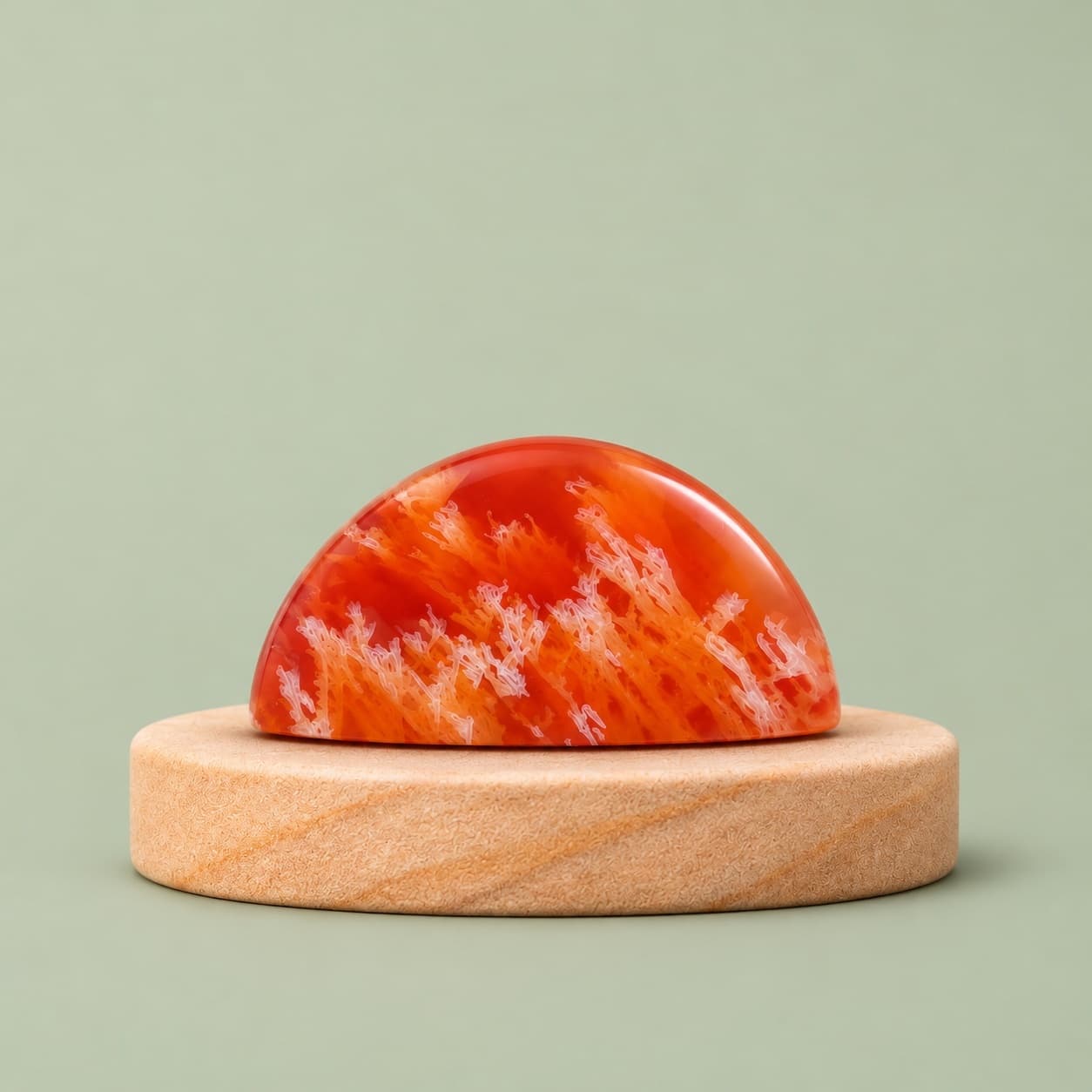
Cabochon dome geometry is the most consequential decision a lapidary makes after choosing the rough. Dome height, the rise from girdle to apex, determines how much light a stone gathers, how deep its colour reads, how the highlight travels across the surface, and how the finished piece sits in a bezel. Two cabochons cut from the same slab with identical outlines can look like different materials once the dome changes.
This guide covers the optics behind dome height, practical height-to-width ratios, how to match a profile to Indonesian agate, jasper, and phenomenal material, and how collectors can read a finished dome before they buy.
What Dome Height Actually Controls
A cabochon is a lens with a flat base and a curved crown. Light arriving at the dome is partly reflected at the surface and partly transmitted into the stone, where it scatters off inclusions, grain boundaries, and microcrystalline structure. The curvature decides the angle at which that scattered light meets the inside of the dome again.
For quartz-family materials such as agate, chalcedony, jasper, and silicified wood, the refractive index sits around 1.544 to 1.553 depending on variety, which puts the critical angle close to 40 degrees (Mindat). Light striking the inside of the dome steeper than that angle is reflected back into the stone instead of escaping; light arriving shallower leaks out through the surface. Dome height is how a cutter steers most of the internal light back toward the viewer.
Three effects follow: light return, or how evenly the dome gathers diffuse light; colour depth, since a longer light path through the stone absorbs more and reads more saturated; and highlight behaviour, where an interrupted curve breaks the moving specular highlight and reads to a buyer as a flat spot.
The GIA Gem Encyclopedia defines the cabochon by its domed crown and flat base, which is exactly why the profile, not the outline, carries most of the cut quality.
The Optical Difference: Window or Glow
Why shallow domes window
When a dome is too shallow for the material, light passes straight through and exits the back. Face up, the stone shows a dark, see-through zone: the window. The effect is strongest in clean translucent agate and opalized wood, and it is the most common reason a well-polished cabochon still looks dead.
Why over-tall domes go dark
Past a certain height, extra material stops adding light return and starts subtracting it. Path length keeps increasing while the useful aperture of the dome narrows, so the stone darkens from the rim inward and the perimeter turns nearly black.
The answer is rarely as high as possible or as flat as possible. It is the height at which the stone returns an even field of light from edge to apex.
Workable Dome Ratios
Dome height is normally expressed as a percentage of the girdle width. Trade practice is consistent enough to plan around, though every cutter adjusts for the individual stone:
Low dome: 20-30 percent
Suited to opaque, patterned stones and to thin rough. The pattern stays flat and legible, the setting profile is shallow, and the stone wears comfortably in a ring. The risk is windowing on anything translucent.
Medium dome: 30-45 percent
The default commercial profile and the safest choice for most Indonesian agate. It balances light return, colour depth, and setting height, and it is the profile most stock bezels assume.
High dome: 45-60 percent and above
Reserved for translucent material that needs colour depth, and for phenomenal stones. Star and cat's-eye material needs a high, precisely oriented dome to focus the reflected band; fine star stones commonly run 40-60 percent of the diameter.
Matching the Profile to Indonesian Material
Agate, carnelian, and chalcedony
Material from Sumatra, West Java, and Sulawesi is usually translucent enough to reward a medium to high dome. Banded agate wants enough height to keep the banding readable in profile without darkening the centre; carnelian wants height to build saturation. Cut these on the high side of medium and check for windowing at every grit stage, not only at polish.
Jasper and opaque patterned stone
Bumblebee jasper from West Java and brecciated jasper are opaque, and their value sits in the pattern. A low to medium dome keeps that pattern flat and undistorted. Push a jasper too high and the pattern begins to wrap around the shoulder, which reads as smearing at the edge.
Fossil wood, palm root, and palm bone
Silicified wood brings grain, porosity, and occasional hardness contrasts. A moderate dome hides minor pits without exaggerating them and keeps the grain visible. Where the material carries a colour layer, as in opalized wood, the dome has to follow that layer rather than an ideal ratio.
Phenomenal material
Chatoyant and star stones are their own case: orientation first, height second. The base must sit perpendicular to the inclusion plane, and the dome must be tall enough to focus the reflection.
Girdle and Back Geometry
Dome height means little without a clean girdle. Keep the girdle at roughly 10-15 percent of total height, of even thickness all the way round, with the edge very slightly rounded. A sharp girdle chips during setting; an uneven one rocks in the bezel.
The back matters more than most cutters admit. A flat, lightly polished base is standard. A slightly convex base adds light return in open-back settings and is worth the extra material on translucent stones. A concave base is the traditional fix for over-dark rough, thinning the stone without touching the dome.
Cutting a Consistent Dome
- Template the outline and mark the girdle line on the preform.
- Establish the girdle on a coarse diamond wheel, keeping the outline perpendicular to the base.
- Chamfer the shoulder at 45-60 degrees to the girdle. This sets the starting angle of the dome.
- Blend the dome on successively finer wheels, rotating the stone continuously and checking the profile against a side light every few passes.
- Run a pencil test. A pencil laid across the dome should touch only near the apex and lift away smoothly in every direction.
- Polish on felt or leather with cerium oxide for agate and jasper.
The pencil test and the travelling highlight catch most dome faults before polish, when they are still cheap to fix. If you would rather not cut the rough yourself, the custom lapidary service handles shaping and finishing from supplied material.
Judging a Finished Dome as a Buyer
Assess dome quality in under a minute:
- Tilt the stone under a single light. The highlight should travel smoothly from edge to apex and back. Any jump, stall, or second highlight is a flat spot left from the grinding wheel.
- Check the apex position. On an oval, the apex should sit on the long axis, centred, not drifted toward one end.
- Read the profile, not only the face. Ask for a straight-on side photograph. Total thickness is not dome height, and a thick base can disguise a shallow crown.
- Test the girdle by rolling the stone on a flat surface; it should not wobble.
Browse cabochons already cut and measured to calibrate your eye, or look through rough material if you plan to cut your own.
FAQ
Does a taller dome always mean a better cabochon?
No. Height sharpens optical phenomena and deepens colour, but past the useful point it darkens the stone and adds weight that never shows face up. Height should serve the material.
What is the ideal dome height for agate?
Most translucent agate reads best at 30-45 percent of the girdle width, using the high end for pale or strongly banded material and the low end for thin slabs or very clean, dark material.
Can a shallow dome be fixed?
Sometimes. Re-doming costs outline size and means starting again from a coarse grit. A shallow dome with a window is usually easier to rescue than an off-centre apex, because the outline can be trimmed and the curve re-established.
How do I photograph a cabochon dome accurately?
Use one diffused light at roughly 45 degrees, shoot straight on for the face and at 90 degrees for the profile, and include a scale. Two lights flatten the dome and hide exactly the faults a buyer needs to see.