
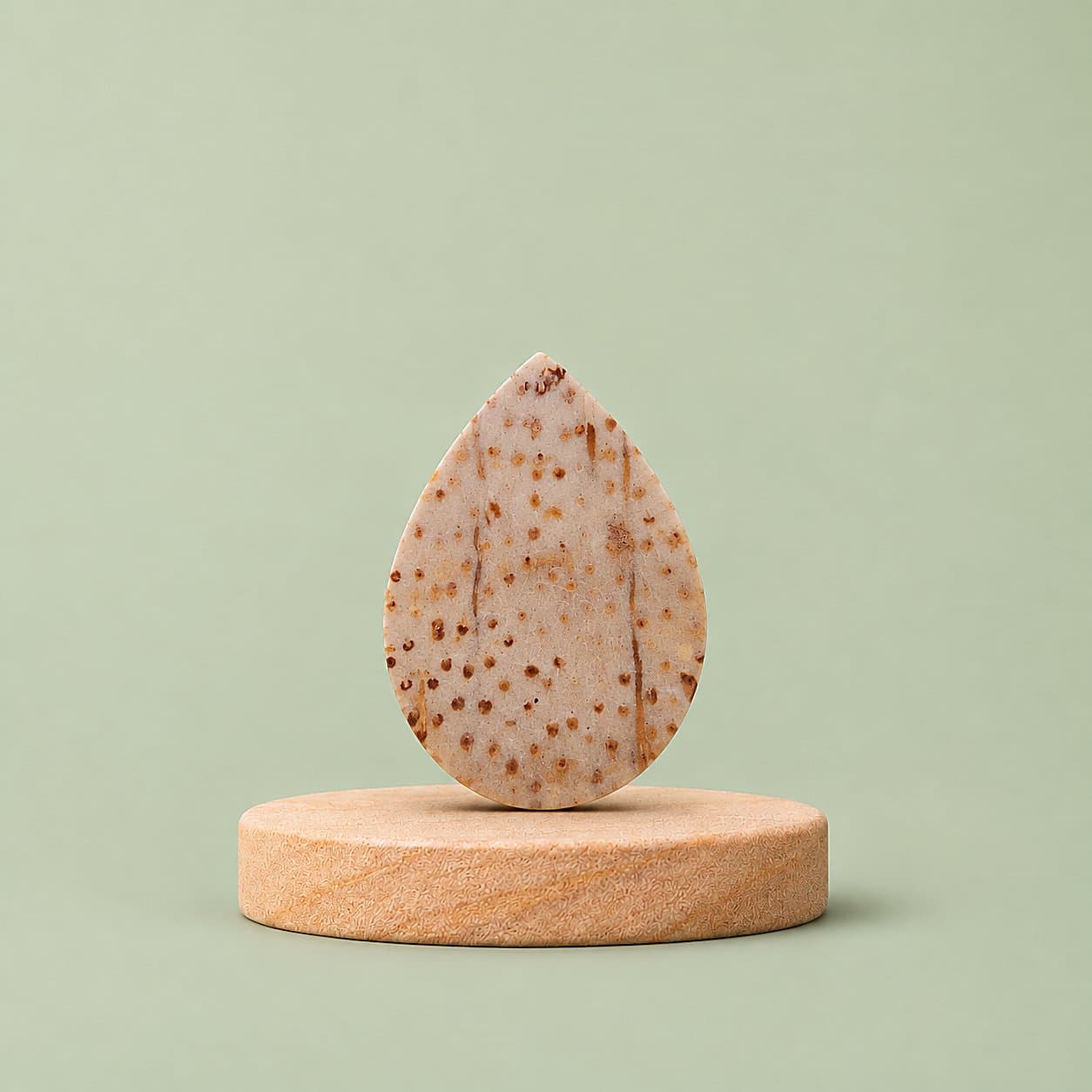
Palm root agate is the polished, silica-preserved root system of ancient palms from Indonesia. It is one of the most recognizable silhouette-fossil materials in the lapidary market: a stone cut from it shows dark, almost black ground mass against golden-brown, honey, or cream grain. Jewelers and collectors prize it because the pattern is unmistakably biological—no two slabs repeat it.
This guide covers how palm root agate forms, how cross and longitudinal cuts differ, and what to check before buying.
What Is Palm Root Agate?
Three overlapping trade names are in circulation:
- Palm root agate — the fossilized root system of an ancient palm, usually from Indonesia.
- Fossil palm wood / petrified palmwood — the trunk or stem; in scientific writing this is assigned to the form genus Palmoxylon.
- Palm root stone — a loose retail term for either material.
The Rock & Gem Magazine profile of Indonesian fossil palm root describes it as "not very common in the marketplace" and "rather scarce", with its appeal coming from high-contrast earthy tones against a near-black matrix. Decent material is harder to source than many better-known Indonesian stones.
Geological Formation: How a Palm Root Becomes Agate
The formation story follows a classic permineralization and replacement pathway. When a palm dies and its roots are buried by volcanic sediment or flood deposits, the tissue gradually decays; groundwater rich in dissolved silica then infiltrates the voids, depositing opal, chalcedony, and sometimes quartz inside and around the anatomical structure. The U.S. National Park Service describes this pairing of permineralization and replacement as the two processes that create fossil wood.
Indonesia's silica-rich volcanic soil makes its palm root and palm wood fossils comparatively well-preserved and colorful; over millions of years, the root's tissue is replaced by dense silica, preserving the vascular architecture down to the scale a lapidary can polish.
Silica Composition and Hardness
Rock & Gem reports an approximate Mohs 6 for the Indonesian material, which is slightly below the 6.5–7 typically measured on a pure agate seam. The lower hardness comes from a mix of silica phases and porous zones between grain bundles, so it shapes readily but should not be assumed to have the polish resistance of a Mohs 7 agate.
Color comes from trace element and mineral variation: hydrated iron oxides push the grain toward golden brown and honey; manganese or other dark mineral zones deepen the matrix toward black, charcoal, or deep brown. The classic "fire against midnight sky" palette—Rock & Gem's phrase—reflects this iron-on-black contrast.
The Anatomy Under the Pattern: Vascular Bundles
Palms are monocots: instead of annual rings, their stems and roots are filled with scattered vascular bundles—fiber-and-vessel rods—embedded in a softer ground tissue. When the bundles mineralize more densely than the surrounding ground tissue, the fossil responds to cutting in a distinctive way.
A recent study in the Springer plant fossil record described a cross section of fossil palm wood showing "sparsely distributed fibrovascular bundles embedded within a mesh like ground tissues", visible even to the naked eye. That anatomy is what makes a palm-root cross cut so recognizable.
This also explains why collectors and cutters separate palm material into two grain readings:
- Cross cut (perpendicular to the root axis): bundles appear as dots, dashes, or short rods—a "dotted-looking" pattern; root-zone cross cuts often show rounded openings and clustered bundles.
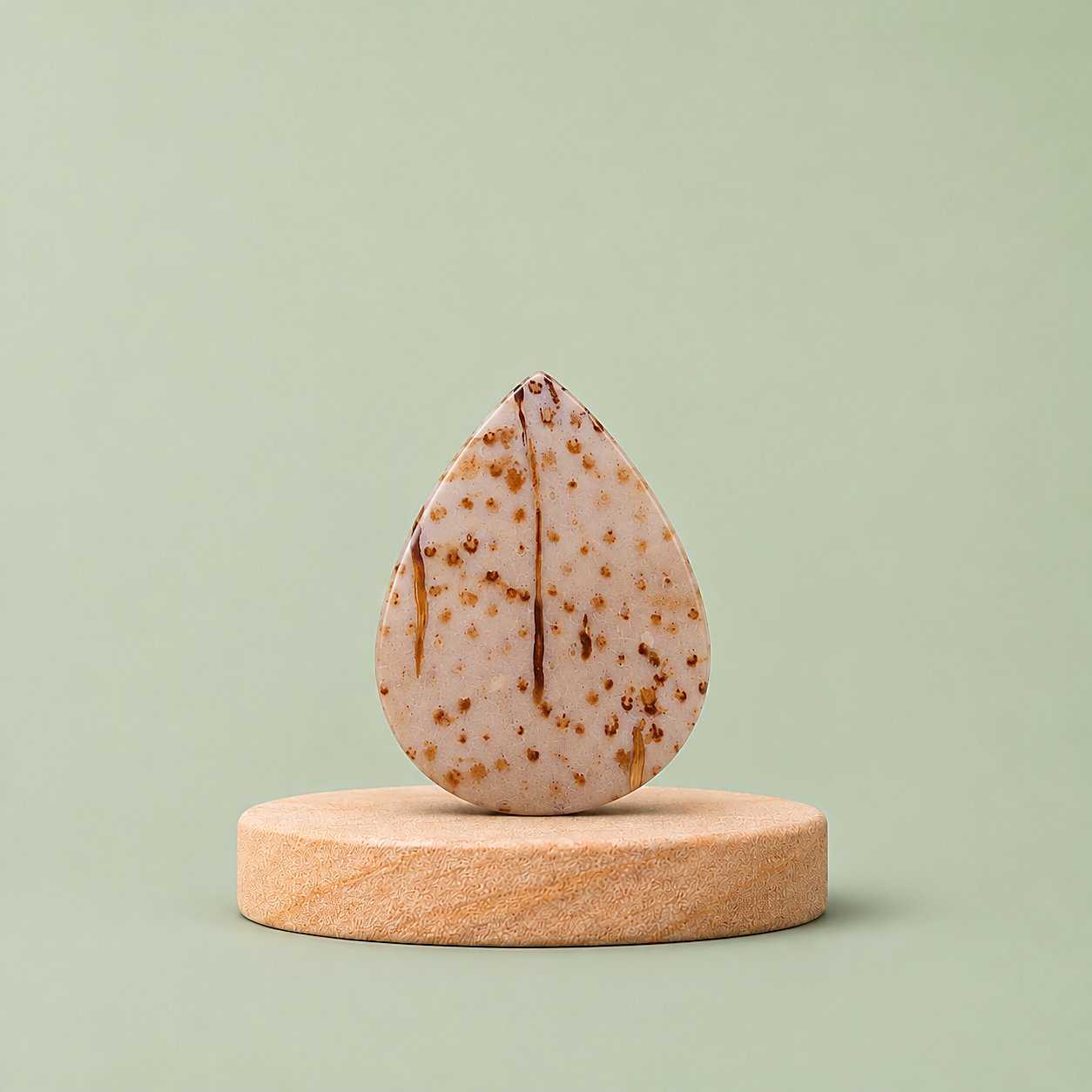
- Longitudinal cut (parallel to the axis): the same bundles become continuous lines, waves, or trails—a "line grain" that reads more like flowing wood grain than a field of dots.
One stone can contain both zones, so orientation matters during slabbing—an abrupt change in grain direction can look like a boundary between two different fossils at first glance.
Lapidary Work: Cutting, Stabilizing, and Polishing Palm Root
Indonesian fossil palm root is a friendly cabbing material, but a few pitfalls trip up even experienced lapidaries. Rock & Gem's operational advice from cutting this material repeatedly is practical:
- Mohs ~6 hardness. It shapes easily, but the designer should respect that it is not a Mohs 7 agate.
- The outer edge is the weak zone. Porous and softer than the bulk, so preform designs should start at least 3 mm to 5 mm inside the edge to avoid pitted or chipped rims.
- Slabbing is tricky. The rough comes in odd shapes, so secure the stock well before sawing; Rock & Gem recommends 5.5–6 mm slab thickness.
- Lighter hematite-tinted zones are slightly softer than darker zones. This can cause undercutting when both hardnesses are ground side by side; finishing the profile on a 220 steel wheel evens the surface before fine sanding.
Pattern Changes Under the Dome
Because grain bundles change over a distance of just 1 mm, the pattern visible on the flat slab rarely matches what appears after doming a cabochon. This is not a defect—it is simply how palm root agate behaves. Designers who want a specific story—the dots, a wave, a "fire" burst—grind and re-read the pattern at intermediate stages; flat-top cabs are the alternative when the pattern must stay exactly as it sits on the slab.
Finish and Care
Most lapidaries stop at around 14,000 grit for palm root agate, which already yields an attractive finish. Going finer—to about 50,000 grit—produces a mirror finish, and in most cases no extra polishing compound is needed, Rock & Gem notes. Finished cabs should not be struck sharply and should be stored away from harder quartz stones; a dry or barely damp soft cloth is all the cleaning finished jewelry needs.
Grading, by convention among dealers and lapidaries, rewards three things: contrast (how cleanly the dark matrix separates the golden grain), anatomical clarity (how readable the bundle pattern is, whether dots or lines), and structural integrity (few pits, cracks, or soft porous zones, especially near the dome edge of a cabochon).
Where Palm Root Agate Sits in the Indonesian Fossil Market
Indonesia is the dominant commercial source, and its fossil palm deposits are frequently cited in association with the region's other silicified botanical and coral fossils. Because palm root is scarcer than standard petrified wood, it is valued both as a workable stone and as a collector item.
The material reaches buyers as pre-cut lapidary slabs, polished display stones, and finished cabochons; because the pattern is biological, each finished piece is effectively one-of-a-kind.
Frequently Asked Questions
Is palm root agate actually an agate?
Trade name aside, it is better described as silicified palm root—a fossil whose tissue has been replaced or filled by silica minerals such as chalcedony, opal, and quartz. It lacks the concentric banding that defines a classic agate; the "agate" label is a market convention for dense, silica-rich, cabochon-grade fossil palm material.
How hard is palm root agate?
Around Mohs 6, per published working notes from lapidaries who cut Indonesian material regularly. Durable enough for pendants, earrings, and occasional-wear rings, but slightly softer than a Mohs 7 agate, so store it away from harder quartz stones.
Why does the pattern change when a cabochon is cut and domed?
The bundle distribution is three-dimensional and changes over distances as small as 1 mm. Sawing removes material and doming exposes a new plane through the bundles, so dots can become line segments and a "fire" focus can shift or disperse. If the exact pattern matters, choose a flat-top cut.
What should I ask a seller before buying palm root agate?
Three practical questions: (1) Is the material root or trunk, and roughly which Indonesian region does it come from? (2) Is the cut a cross cut or a longitudinal cut—this determines dot grain versus line grain? (3) Are there soft or porous zones, especially near the edge, and has the slab been stabilized if so?
Conclusion: A Fossil That Reads Like Fire
Palm root agate offers something rare: a fossil that is anatomically verifiable—legible vascular bundles—and endlessly varied at the cutting bench. Indonesian material, with its black matrix and iron-toned grain, is the reference standard for both workability and visual punch.
If you are building a cabochon inventory or scouting a one-of-a-kind stone for a setting, palm root agate rewards patience at the layout stage. Browse our natural Indonesian stone shop, inspect the current rough slabs for lapidary, explore finished cabochons, or look at display-grade fossil specimens to see how palm root reads in different cuts.