
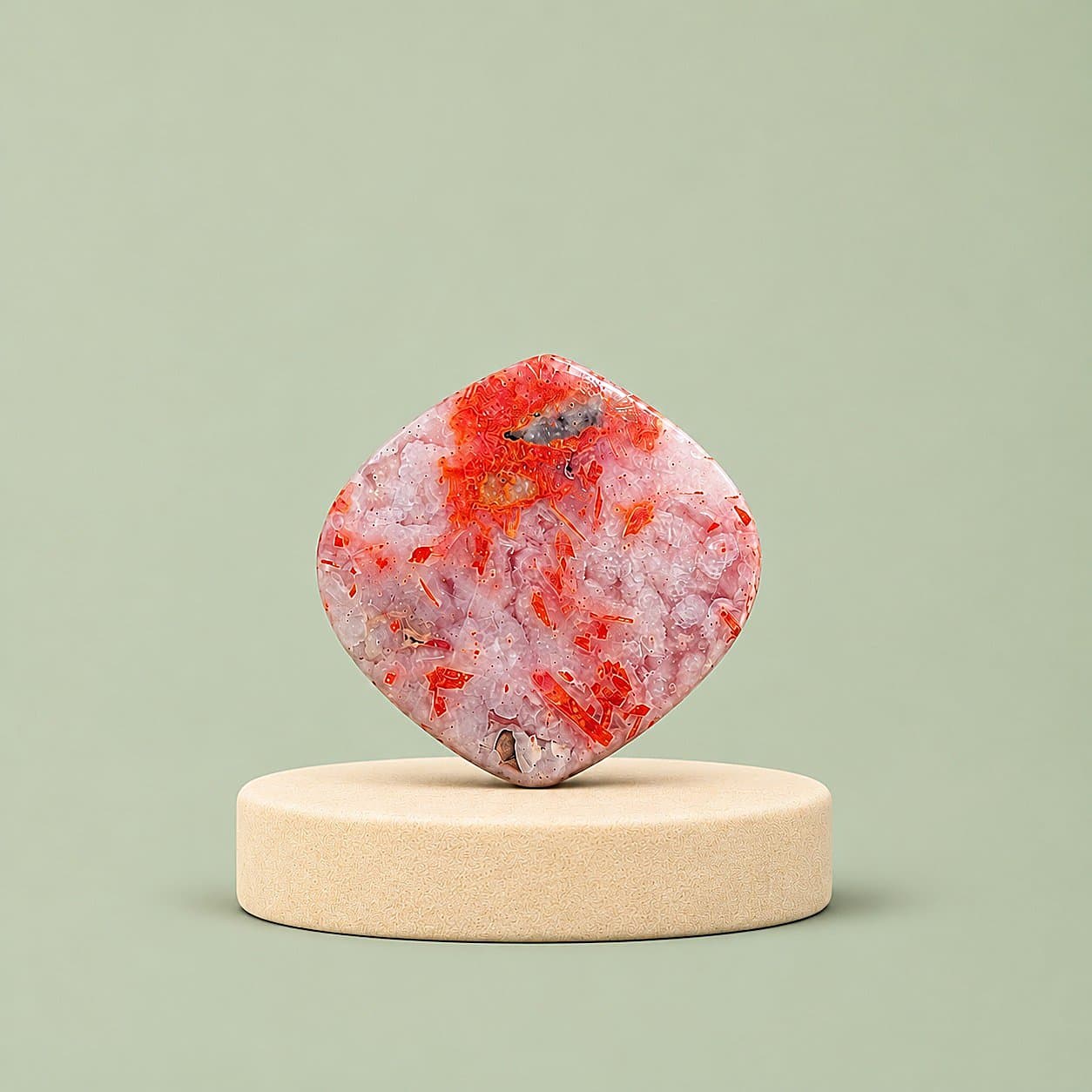
Indonesia's position on the Ring of Fire is not only a volcanic hazard story; it is a gem-forming engine. Along the Sunda and Banda arcs, the subduction of the Indo-Australian plate beneath the Eurasian plate generates magma, fractures, and circulating fluids that alter volcanic rocks. Those fluids dissolve silica and trace metals, then reprecipitate them in cavities and fractures. The result is a family of stones that lapidaries and collectors associate with Indonesia: agate and chalcedony, common and precious opal, plume agate, and the volcanic-vent stone sold as bumblebee "jasper."
This article explains the hydrothermal pathway, the temperatures and time scales involved, and why Indonesian stones often carry mixed mineral phases that make them beautiful but challenging to cut. It is written for collectors, jewelry designers, and lapidaries who want to read a stone's formation history in its inclusions.
Indonesia's Place on the Ring of Fire
The Indonesian archipelago is the westernmost segment of the Ring of Fire, the tectonically active belt that rings the Pacific. Subduction, volcanism, and high heat flow create the conditions for hydrothermal circulation: water and magmatic fluids move through fractured volcanic rock, leaching silica, iron, manganese, sulfur, and arsenic. Geothermal fields, fumaroles, and hot springs are the surface expression of the same systems that, at depth and over long time scales, fill rock cavities with gem material. The USGS and GIA both treat volcanic terranes as important hosts for silica gems, especially where fluids can access open space.
What a Hydrothermal System Is
Low-Temperature Fluids, Not Just Magma
Hydrothermal does not mean molten rock. In gem formation, the fluids are usually low- to moderate-temperature water—meteoric water that has circulated through hot volcanic rock, sometimes mixed with magmatic gases. The Lotus Gemology agate review notes that agate forms at temperatures from about 20 to 230 °C. At those temperatures, silica is transported as silicic acid and deposited as amorphous silica, opal, or chalcedony. Trace elements carried in the same fluids—iron, manganese, copper, sulfur, arsenic—create color and inclusions.
Fluids Need Open Space
For a gem to form, the fluid needs a cavity: a gas vesicle in basalt or andesite, a fracture, a breccia void, or dissolved limestone. Deposition begins on the cavity walls and grows inward. Banding, plumes, and fortification patterns record changes in fluid chemistry, temperature, and flow over time.
From Volcano to Gem: The Silica Pathway
Vesicles, Fractures, and Void Filling
Most agate and chalcedony in volcanic rock begins in vesicles—gas bubbles trapped as lava cools. As the rock fractures and fluids circulate, silica-rich solutions enter these voids. Repeated pulses deposit layers of chalcedony, sometimes alternating with jasper, opal, or oxide films. The GIA notes that chalcedony forms in volcanic rocks that contain gas cavities, precipitating from volcanic fluids from the walls inward. Over time, a hollow nodule can become a solid agate or a geode with a quartz crystal lining.
Temperatures and Time Scales
Gem formation is slow. Bumblebee jasper deposits, for example, are described as accumulating over hundreds of thousands of years at a volcanic vent. Silica polymerization, dehydration, and crystallization from gel to chalcedony are not instantaneous. This is why Indonesian stones often show complex, layered interiors rather than uniform color.
Indonesian Stones Shaped by Hydrothermal Fluids
Bumblebee "Jasper" (West Java)
Despite its trade name, bumblebee "jasper" is not a true jasper. Rock.id and Stone Mania describe it as a calcite/aragonite-dominated material colored by sulfur, realgar, orpiment, pyrite, and iron oxides. It forms where hot, gas-rich fluids alter limestone near volcanic centers such as Mount Papandayan and, later identified, the lower slopes of Mount Ciremai. The process is hydrothermal alteration: volcanic fluids replace and recrystallize limestone, depositing sulfur and metal-bearing minerals in successive layers. The result is soft (calcite matrix), reactive, and visually dramatic—but not a silica jasper.
Agate and Chalcedony (West Java, Sumatra)
Indonesian agates typically form in volcanic cavities and fractures. Iron and manganese oxides create red, brown, and black banding; copper and other trace elements can produce green and blue tones. Picture jasper and landscape agate from Sukabumi are examples of silica deposition recording subtle changes in fluid chemistry. These materials are hard (Mohs 6.5–7) and take a high polish, but they may contain soft inclusions or fractures.
Opal and Fire Opal
Opal is hydrated amorphous silica. GIA explains that opal forms by precipitation from silica-rich water moving through cracks, pores, and voids. Fire opal forms by leaching followed by deposition of silica in porous volcanic rocks. In Indonesia, opal ranges from common potch to precious material with play-of-color. The IAGI study of Banten opal attributes much of that deposit to weathering of volcanic glass under waterlogged conditions, a reminder that not every Indonesian opal is strictly hydrothermal; meteoric and weathering processes also matter.
Agatized Fossil Coral
In West Java and Sumatra, fossil coral skeletons are replaced by silica-bearing fluids of volcanic origin. The calcium carbonate of the coral is gradually substituted by chalcedony and quartz, preserving the radial corallite structure. Iron, copper, and other metals precipitate with the silica, giving the stone its color. This is a hydrothermal/diagenetic hybrid: biological structure plus volcanic fluid chemistry.
Why Inclusions Tell the Story
Inclusions are not flaws; they are records. Iron oxide dendrites, copper silicate patches, sulfur bands, and manganese seams mark the chemistry of the fluids that passed through the stone. A cutter who understands those phases can predict undercutting, choose dome height, and avoid fractures. Collectors can use inclusion patterns to distinguish natural formation from treatment: dyed stones tend to color fractures and pores uniformly, while natural inclusions follow growth structures.
Practical Notes for Lapidaries and Collectors
Cutting Mixed Phases
When a slab contains both Mohs 6.5–7 chalcedony and Mohs 2–4 soft inclusions, the softer phase undercuts during grinding and polishing. Use fresh, sharp diamond wheels, light pressure, and frequent inspection. Preform with the hardest phase in mind, and expect to re-polish soft areas by hand. Stones with open fractures should be stabilized only if the treatment is disclosed; otherwise, cut around the fracture or use the stone as a specimen.
Safety with Sulfur- and Arsenic-Bearing Stones
Bumblebee "jasper" contains sulfur and arsenic-bearing minerals. Cut it wet, use local exhaust or a mask rated for mineral dust, and avoid dry grinding. Do not heat the stone; heating can release sulfur fumes. Clean tools and work surfaces after cutting, and store specimens away from children and pets. These precautions apply to any stone with sulfide inclusions.
FAQ
Are all Indonesian gemstones volcanic?
No. Many are volcanic or hydrothermal, but some, such as agatized fossil coral, involve biological structures and diagenesis. Weathering of volcanic glass also plays a role in opal formation.
Is bumblebee jasper a real jasper?
No. Its matrix is mainly calcite/aragonite, not quartz. The name is a trade name for a hydrothermally altered limestone colored by sulfur and arsenic minerals.
What temperature forms agate?
Agate typically forms at low to moderate temperatures, roughly 20 to 230 °C, from silica-rich fluids.
Why do Indonesian stones have so many colors?
Trace elements—iron, manganese, copper, sulfur, arsenic—are carried by hydrothermal fluids and precipitate with silica. Each deposit has its own fluid chemistry.
Can hydrothermal stones be treated?
Yes. Opal can be smoked or sugar-acid treated to darken the body; agate can be dyed. Ask for disclosure and documentation.
Where can I buy Indonesian hydrothermal gems?
Browse RENDI VIRGO's catalog at /shop, including /shop/rough for lapidary material, /shop/cabochons for finished stones, and /shop/specimen for display pieces. Custom cutting is available through /lapidary.