Indonesian fossil coral is one of the few gem materials that preserves a living architecture in stone. Millions of years ago, reef-building corals grew in the warm seas around the volcanic arc that became Java, Sumatra, and Kalimantan. Volcanic ash buried those reefs, silica-rich groundwater seeped through the skeletons, and calcium carbonate was replaced, molecule by molecule, with chalcedony. The result is agatized fossil coral: a stone that still shows every wall, septum, and calice of the original colony, yet polishes like agate.
Few materials combine an organism's repeating geometry with quartz-family durability. This guide covers formation, pattern reading, grading, cutting, and care.
What Agatized Fossil Coral Actually Is
Fossil coral is not a mineral species but a replacement texture: an aragonite skeleton (CaCO3) progressively swapped for silica (SiO2) while growth geometry stays intact. In the best material, replacement is so complete that the stone is essentially chalcedony with a coral-shaped ghost inside.
The process passes through several silica phases: opal-A, then opal-CT, then microcrystalline quartz and chalcedony. Each step hardens the material. Fully agatized coral reaches about 6.5 to 7 on the Mohs scale, close to ordinary chalcedony, while partly replaced coral still contains soft carbonate that acid can dissolve.
A cabochon that takes a glassy polish is fully silicified. A chalky piece that fizzes in dilute hydrochloric acid still holds calcite and will not wear well.
How Indonesian Fossil Coral Forms
Indonesia sits on the Pacific Ring of Fire. Arc volcanism supplied carbonate reef frameworks built during high sea-level stands, plus vast volumes of ash and tuff; where the two met, fossilization became exceptional.
From Reef to Ridge: The Banten Bay Record
Along Java's northwest coast, Quaternary reef terraces are exposed around Banten Bay and Panjang Island. Studies of Porites corals there show many skeletons kept original aragonite and fine structure, the condition needed for silica to preserve detail rather than erase it. Uplift then exposed the terraces to silica-bearing fluids, turning the same corals into lapidary rough.
Why Volcanic Terrain Matters
Burial in volcanic sediment drives the process. Weathering ash releases mobile silica into formation water. Research on silicified wood from Jasinga, West Java, published in Scientific Reports, shows silica infiltrating organic structures from the surrounding Pliocene tuff and replacing them inward. Fossil coral follows the same logic: the more silica-rich the host sediment and the more permeable the skeleton, the more complete the replacement.
Sumatra's Barisan Range hosts Miocene reefs preserved the same way, and material also occurs in East Java and Kalimantan. Indonesian fossil coral is a family of deposits, not one locality.
Reading the Coral Pattern
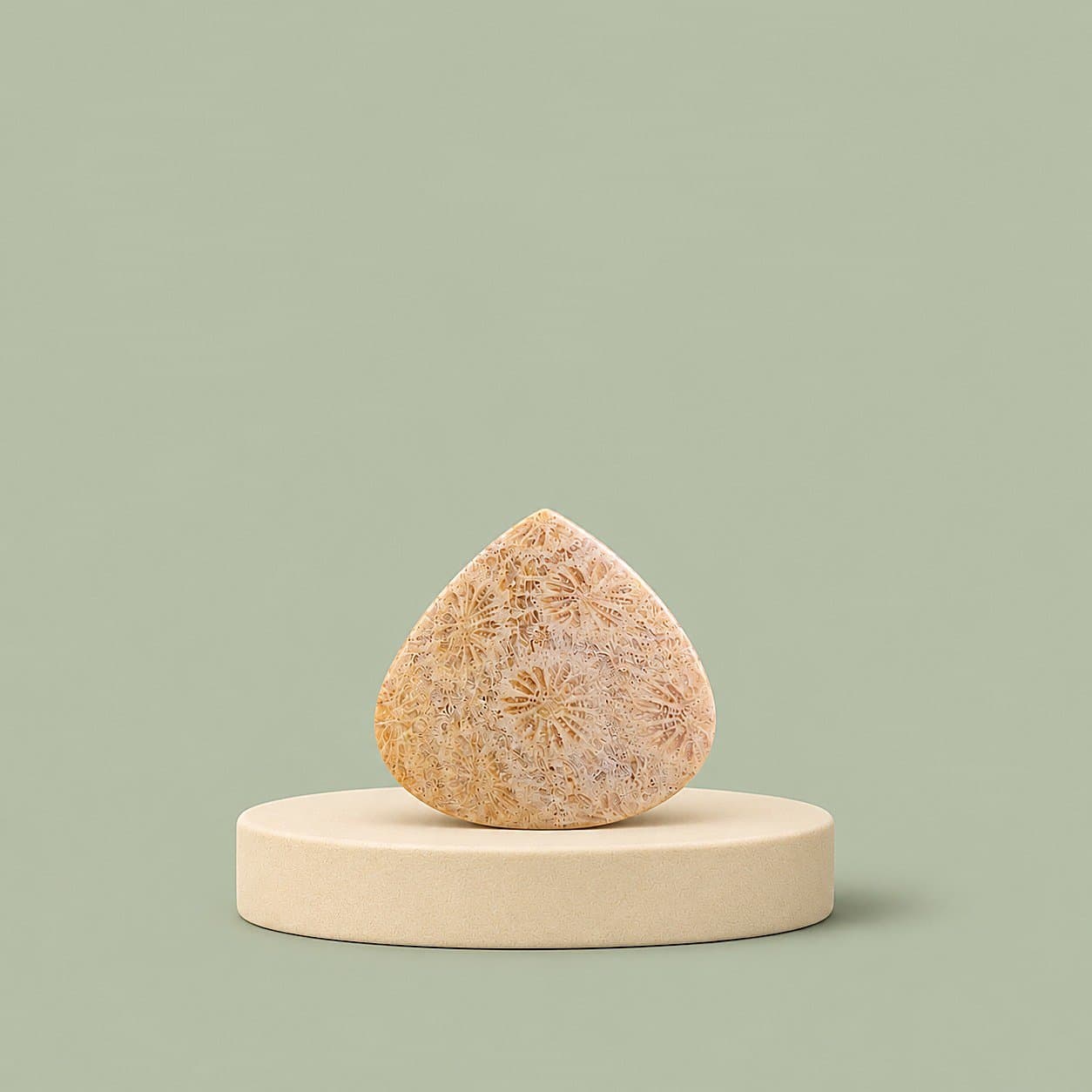
Every agatized coral cabochon is a cross-section through a colony. Circles, stars, and honeycomb cells are corallites, the cups each polyp lived in; radiating lines inside them are septa. Cuts through the top show flower-like rosettes; cuts along the side show parallel tubes.
Common Coral Types in the Trade
- Porites: fine, tightly packed pores; the most common reef builder and source of much Indonesian material. Dense Porites cuts into smooth, subtly translucent cabochons.
- Favites and Goniastrea: larger, thicker-walled corallites that produce the bold honeycomb patterns collectors want.
- Acropora: branching structure; slabs often show elongated voids filled with agate banding.
Why No Two Cabochons Match
Pattern depends on cut orientation: perpendicular to growth reveals full corallite geometry, parallel to growth shows long tubes and stretched bands. Two cabochons from one block can look like different stones, which is why matched pairs command a premium.
Color, Translucency, and Grade
Base color comes from trace minerals in the silica. Iron oxides give cream, honey, orange, and brick red; manganese produces black dendrites and purple-gray tones; organic residue darkens replaced zones to gray. The Indonesian palette runs from bone white through butterscotch to deep red-brown, with rare lavender and pink.
Grading comes down to five factors:
- Pattern definition. Crisp corallite outlines with visible septa beat vague blotches, and should hold up under a loupe.
- Color saturation and contrast. Strong, even color with clear separation between walls and voids; muddy tones lose value.
- Translucency. Gem-grade material glows when backlit. Opaque, chalky pieces are utility grade.
- Structural integrity. Fractures, vugs, and soft carbonate pockets are defects; one crack across a dome can end a project.
- Size and shape. Large clean domes and matched pairs are scarce, since most rough yields small cabochons.
Natural, Dyed, or Fake: Field Tests
Indonesian fossil coral is dyed and stabilized routinely, and both are legal when disclosed. The problem is undisclosed treatment or imitation.
- Loupe inspection. Natural coral walls vary in thickness and follow organic curves. Resin casts show bubbles, uniform walls, and mold seams; dye pools in fractures.
- Acetone swab. Rub an inconspicuous area with an acetone-dampened swab. Color on the swab means dye.
- Acid test. A drop of dilute hydrochloric acid fizzes where calcite remains, meaning the piece is only partly silicified.
- Heated pin. A hot pin on a hidden surface smells of resin in stabilized or imitation material. Use sparingly.
Buy from sellers who state locality and treatment. Provenance is part of the value.
Cutting and Polishing Agatized Coral
Fossil coral rewards a slow approach because hardness is not uniform. Fully agatized walls may sit at Mohs 7 while adjacent carbonate or clay-filled voids are far softer, causing undercutting and a rippled surface.
- Orient before you cut. Slab a test slice and wet it to see the pattern, then choose a cross-section rosette or a longitudinal tube pattern.
- Stabilize early. Wick thin cyanoacrylate into fractures and porous zones after rough grinding.
- Grind in stages. 220 grit to establish the dome, 400 and 600 to remove scratches, 1200 before polish. Keep the stone wet and cool; heat checks appear fast.
- Polish on felt or leather. Cerium oxide with water gives the best glassy finish; diamond paste can haze on a hard lap.
- Watch the edges. Coral walls near the girdle are where undercutting and chipping start, so keep pressure light.
Our lapidary service handles custom cutting for collectors who want a specific slab orientation, and the cabochon catalog shows how patterns read once polished.
Care, Wear, and Display
Fully agatized fossil coral is durable enough for rings, pendants, and bolos, but not indestructible.
- Clean with warm water and mild soap, then dry with a soft cloth.
- Skip ultrasonic cleaners and steam if carbonate remains; vibration and heat can open fine fractures.
- Keep acids, bleach, and ammonia away. Even weak acids attack residual calcite and dull the polish.
- Store separately from harder stones, and display out of direct sun; dyed material fades.
Buying Indonesian Fossil Coral
The strongest buys combine a clear locality, a pattern that survives cutting, and honest disclosure. Single cabochons in the 20 to 60 dollar range are typically mid-grade with good color but modest translucency. Translucent, high-contrast pieces and matched pairs sit higher and hold value.
One legal note: modern stony corals are listed under CITES Appendix II, but fossil coral is mineralized fossil material, not living reef, and is traded as stone. Browse current material in the cabochon collection, including a polished fossil coral cabochon, or start from slabs in the rough materials section.
FAQ
Is fossil coral the same as living coral?
No. It is an ancient skeleton replaced by silica and is legally and physically a stone. Living reef coral is protected, and trade in modern stony corals is regulated under CITES.
How hard is agatized fossil coral?
Fully silicified material measures about 6.5 to 7 on the Mohs scale and suits everyday jewelry. Partly replaced pieces with calcite are softer and should stay out of rings.
Can Indonesian fossil coral be dyed or stabilized?
Yes, both are common and legal when disclosed. Dye deepens color in pale material; resin holds fragile pieces together. Ask for disclosure and test with acetone on a hidden spot.
Where does Indonesian fossil coral come from?
West Java, including Quaternary reef terraces around Banten Bay; Sumatra's Barisan Range, where Miocene reefs are preserved; and East Java and Kalimantan. Each locality has its own color range and pattern character.