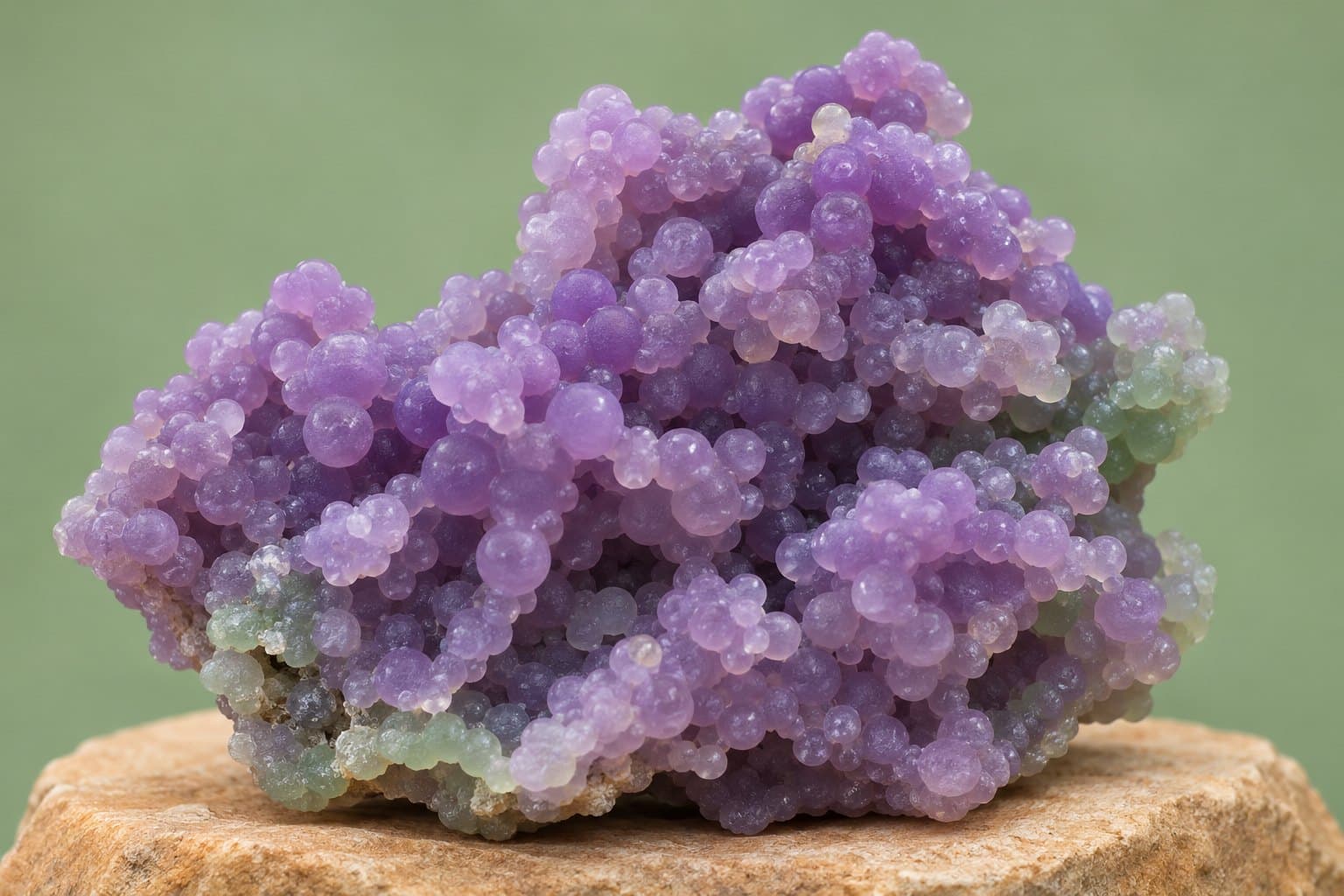
Manakarra grape agate is the trade name for a botryoidal chalcedony-quartz material from West Sulawesi, Indonesia, whose surface erupts in tight clusters of spherical "grapes" — most often in shades of lilac, lavender, and deep amethystine purple. Traded locally as batu manakarra, the stone reached the international mineral market around 2016 and quickly became one of the most recognizable Indonesian specimens in United States and European collections.
Despite the name, grape agate is not a true agate. Thin-section examination of Mamuju material reveals radially grown quartz rather than the concentric banding that defines agate, which is why mineralogists prefer terms such as "botryoidal chalcedony" or "grape amethyst" for the purple material. The name stuck anyway — and today "grape agate" is the search term collectors actually use.
How Grape Agate Forms: Volcanic Vugs and Radial Quartz
Western Sulawesi sits on the Pacific Ring of Fire, a volcanic corridor stitched with gas cavities and hydrothermal veins. Silica-rich fluids percolated through these voids and, instead of growing as a flat lining or banded fill, precipitated as radiating spherules — sphere after sphere nucleating on the cavity walls until whole bunches of botryoids filled the space. The Mindat locality record for Manakarra documents the geology of this mining district in detail.
Why the Grapes Stay Round
Each sphere is a radial aggregate of quartz crystals that grew outward from a single nucleus. New nuclei kept forming on the growing surface, so the aggregate advanced as packed hemispheres rather than flat layers — the classic botryoidal habit, defined in the Mindat chalcedony entry. Individual "grapes" typically measure 2–10 mm, and the finest specimens show dozens of intact, evenly sized spheres pressed together like fruit in a market crate.
Where the Purple Comes From
Trace-element chemistry drives the color. Purple tones are associated with manganese-bearing inclusions acting much like amethyst's coloring agents, while green to blue-green zones are traced to celadonite, a green mica-group mineral common in altered volcanic rock. Many of the most collectible pieces show a natural gradient — a greenish base mass crowned by purple spheres. Some cavities also preserved hollow vugs later lined with fine druzy quartz that glitters under display lighting.
The Manakarra Locality
The material comes from the Batu Manakarra mining district in the Mamuju Regency of West Sulawesi. Early pieces were dug from shallow workings in volcanic tuff and sold in Javanese lapidary markets as batu manakarra — "Manakarra stone" — before American cutters coined "grape agate" for the polished clusters. How much material remains in the ground is unknown; supply has always been irregular, and fine cabinet-sized clusters now command strong premiums relative to when the deposit first flooded the market.
How the Market Grades Grape Agate
The US collector market grades grape agate on four practical axes. Understanding them makes price differences between listings easy to read.
Color Saturation and Coverage
Deep eggplant purple with full botryoid coverage sits at the top of the market. Pale gray-lavender masses with extensive white or brown ground are entry level. Bi-color green-and-purple clusters have become a collector niche of their own — two-tone specimens from a single cavity are genuinely uncommon.
Botryoid Size, Roundness, and Symmetry
Tight, uniform, well-rounded spheres packed in an even arrangement score highest. Elongated, merged, or mealy-textured botryoids read as lower grade even when the color is right.
Surface Finish and Druzy Sparkle
A fine druzy coating on the sphere crowns adds light play that photographs beautifully. Friable, chalky surfaces and loose spheres do the opposite — they signal material that will shed in a display cabinet.
Completeness and Damage
Individual spheres snap off with surprising ease, in the ground and in shipping. Intact crown spheres, undamaged contact points, and a stable base separate museum-grade clusters from craft-grade material. Reputable sellers pad and double-box grape agate precisely because breakage in transit is common.
How to Spot Dyed Grape Agate
Pale material dyed purple floods low-end listings. Telltale signs: a single flat color with none of the natural zoning, dye pooling in crevices between spheres, and a price far below what saturated natural material costs. A simple confirmation test is a soak in water or acetone — dye leaches and discolors the liquid, while natural color is stable. When in doubt, buy from sellers who document locality and treatment, as the International Gem Society notes for chalcedony varieties.
Caring for a Grape Agate Specimen
The quartz itself is durable — roughly Mohs 7 — but the cluster structure is fragile. Handle specimens by the base, never by the spheres. Dust with a soft brush, clean with mild soap and water only, and keep pieces out of ultrasonic cleaners and prolonged direct sunlight, which risks fading the purple. For display, a padded stand on a stable shelf away from vibration prevents accidents.
From Display Case to Jewelry Bench
Cutters who work grape agate face an unusual challenge: every sphere is a tiny dome. Flat laps clip the high points, so most jeweler-grade pieces are cut as freeform cabochons that preserve the botryoidal topography, as described in Rock & Gem's Indonesian grape agate cabbing guide. Friable bases are stabilized before grinding, and the finished stones suit pendants and earrings where the spheres face outward. You can browse polished grape-agate-style chalcedony cabochons in our cabochon collection, or commission a custom polish through our lapidary service.
Collectors who prefer whole clusters will find display specimens of Indonesian botryoidal chalcedony and related minerals in our specimen collection, with the full catalog available in the main shop.
Frequently Asked Questions
Is grape agate actually an agate?
No. Mineralogically it is radially grown quartz and chalcedony without the concentric banding that defines agate. "Grape agate" is a commercial trade name, accepted market-wide even though the stone is more accurately described as botryoidal chalcedony or grape amethyst.
Where does grape agate come from?
The Batu Manakarra mining district in the Mamuju Regency, West Sulawesi, Indonesia. No other locality produces this specific botryoidal purple chalcedony in commercial quantities.
Why is purple grape agate expensive?
Deep saturation, full botryoid coverage, intact spheres, and druzy sparkle rarely occur together in one cluster. The Mamuju deposit is also small and worked irregularly, so supply of top-grade material never catches up with demand.
How can I tell if grape agate is dyed?
Look for one flat color with no natural zoning and dye concentration in the crevices between spheres. A water or acetone soak that leaches color confirms treatment; natural purple is stable in both.
Is grape agate suitable for jewelry?
Yes, with care. The quartz hardness of about 7 on the Mohs scale resists scratches, but the spherical surface is easily chipped, so the stone suits protected settings such as pendants and earrings rather than rings worn daily.