
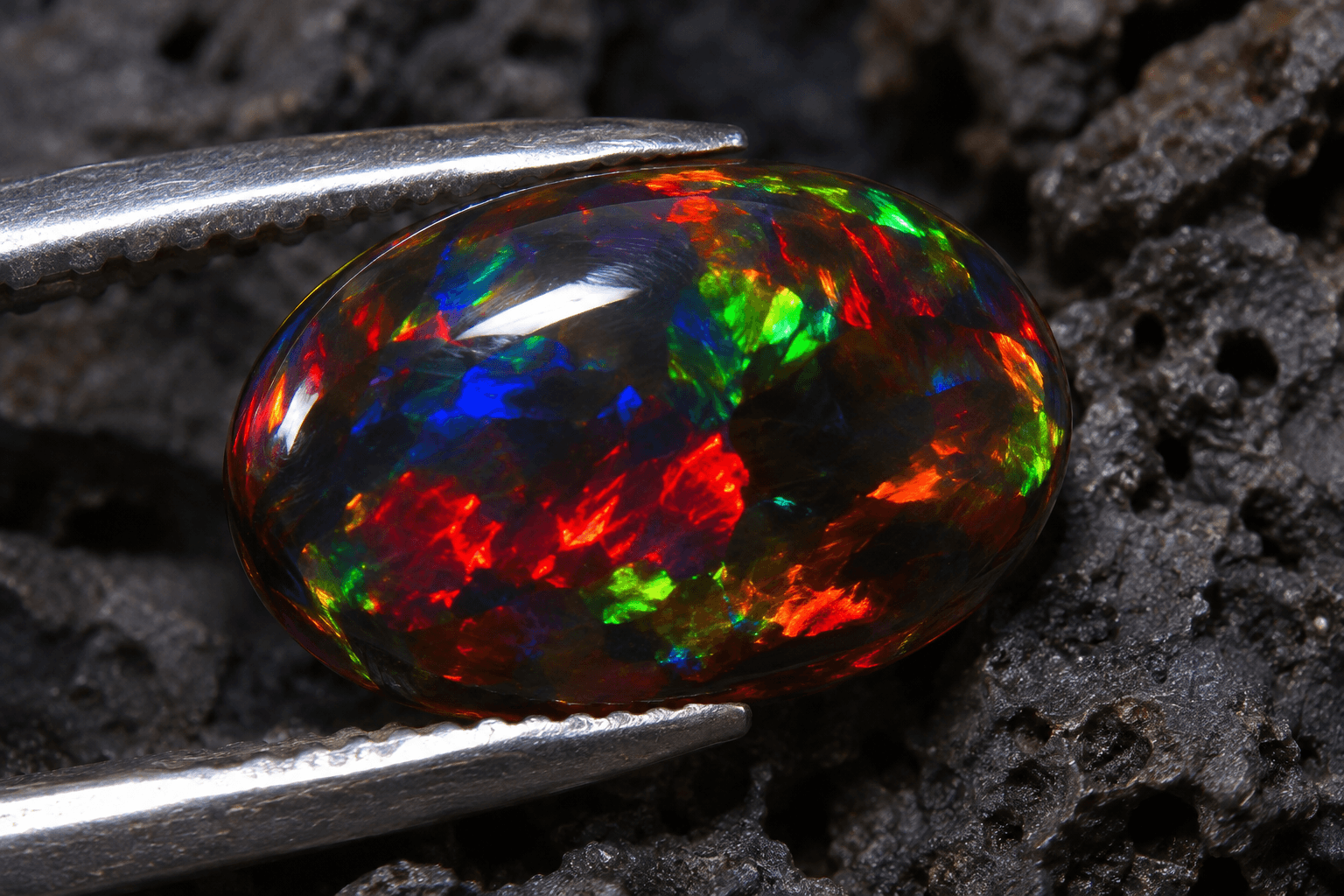
Kalimaya is the Indonesian name for opal from Banten, western Java. The word is often translated as "river of illusion," a fitting description for stones whose colors seem to float and shift as the viewing angle changes. Although Australia is famous for black opal, particularly from Lightning Ridge, Banten has produced precious black opal since the 1970s. It is mined from a strongly weathered pumice layer in the Late Tertiary Genteng Formation, east-southeast of Rangkasbitung, about 150 km from Jakarta.
Banten opal is not a single material. The same volcanoclastic sequence yields common opal, hyalite, fire opal, white precious opal, and black precious opal. Black opal is the rarest and most valuable of these varieties, estimated at roughly 5-10% of total production. Its body color is usually blackish-brown rather than jet black, which gives red, green, yellow, and (less commonly) dark blue play-of-color a strong but natural contrast. Many stones are freeform cabochons or baroque shapes because cutters try to preserve as much weight as possible from irregular nodules.
From a gemmological standpoint, opal is an amorphous hydrated silica with the formula SiO2·nH2O. Banten material has a refractive index of about 1.435-1.468 and a specific gravity of about 1.98-2.06, with the lowest values in transparent stones. Water content can range from about 3% to 21%. Mohs hardness is commonly cited around 5.5-6.5. That softness is one reason Banten opal is often cut as cabochons rather than faceted, and why parcels should be checked carefully for hidden fractures with a 10x loupe before polishing.
The geology is volcanic rather than hydrothermal. The opal occurs in a pumiceous tuff layer 0.30 to 2.3 m thick that has weathered to a greenish-grey, clay-rich rock dominated by montmorillonite. Dutch geologists first noted opal in the area during the 1930s, but meaningful small-scale mining began in the 1970s. Miners work only during the dry season (May to September), sinking hand-dug shafts to about 20 m and following the opal layer for up to 60 m. The host rock is soft and unstable, so much of the production is recovered as irregular nodules, fracture fillings, and opal replacing fossils or fossil wood.
Play of Color and Body Tone
Play-of-color in opal is produced by diffraction of light through an ordered array of silica spheres. In Banten black opal, color patches can be small and symmetrical, sometimes striped or wave-like, and the strongest flashes are usually red, orange, and green. White opal from the same deposit shows more blurred color borders, while fire opal has a yellowish-red body with subdued red, orange, and green flashes. Crystal (translucent) opal is also common and can show symmetrical, small color patches.
Kalimaya vs. Other Black Opals
Natural Kalimaya should not be confused with smoked Ethiopian hydrophane opal, which is often sold online as "black opal." Ethiopian material is hydrophane and can absorb smoke, producing an artificially dark body and unusually saturated fire. Natural Banten opal usually has softer, more understated flashes and a blackish-brown rather than jet-black body. It also differs from boulder opal, which forms in ironstone host rock; Kalimaya forms without a host rock. Compared with Lightning Ridge black opal, Banten material is generally less saturated and less stable, but it has its own volcanic origin and collector appeal.
Care and Durability
Some Banten opal, especially younger or less mature material, can be strongly hydrophane and may temporarily change appearance when exposed to water, oils, or rapid humidity changes. For that reason, avoid ultrasonic cleaners, steam, harsh chemicals, and sudden temperature shifts. Clean gently with a soft damp cloth and dry naturally. Because opal contains water and has a relatively low hardness, store it away from direct heat and abrasive materials, and inspect stones under magnification before setting them in jewelry.
Cutting and Jewelry Use
Banten opal is usually cut as freeform cabochons to maximize yield from irregular rough. Hidden fractures are common and may open during sawing or polishing, so each piece of rough should be examined with a loupe. For jewelry, consider protective settings and avoid thin edges. If you work with rough material, our custom lapidary services can help plan cuts, while our rough collection is a good starting point for lapidary material. Finished cabochons are available in our cabochon collection.
Collecting and Provenance
Most Banten opal is sold within Indonesia, with smaller quantities reaching international gem fairs. Retail prices often fall in the range of roughly USD 50-100 per carat, with black opal commanding the higher end. As with any rare locality stone, documentation matters: record the mining area (Banten/Lebak, Rangkasbitung), variety, treatment status, and photographs. Untreated natural material with a documented locality is more valuable and easier to resell than stones of uncertain origin.
For collectors, Banten opal offers a volcanic, small-scale alternative to more familiar Australian deposits. It is a mineraloid rather than a true mineral, formed from amorphous silica, and its value lies in the combination of geological context, natural color play, and honest, untreated material.
FAQ
Is Kalimaya a real opal?
Yes. Kalimaya is a natural opal from Banten, Indonesia. Like all opal, it is an amorphous hydrated silica and is classified as a mineraloid rather than a crystalline mineral.
Is Banten black opal treated?
Much material on the market is natural, but buyers should be cautious. Smoked Ethiopian hydrophane opal is sometimes sold as black opal. Ask for locality documentation, treatment disclosure, and, when possible, gemmological testing.
How should I care for Kalimaya opal?
Avoid rapid changes in humidity, water immersion, oils, heat, and ultrasonic cleaning. Clean gently and let the stone dry slowly and naturally if it becomes wet.
Why is Banten opal often freeform?
Rough occurs as irregular nodules and fracture fillings in soft host rock. Cutters often preserve weight and natural shape rather than calibrating stones to standard sizes.
Where can I buy Indonesian opal?
You can browse our natural stone catalog for available material, including cabochons, rough, and display specimens.