
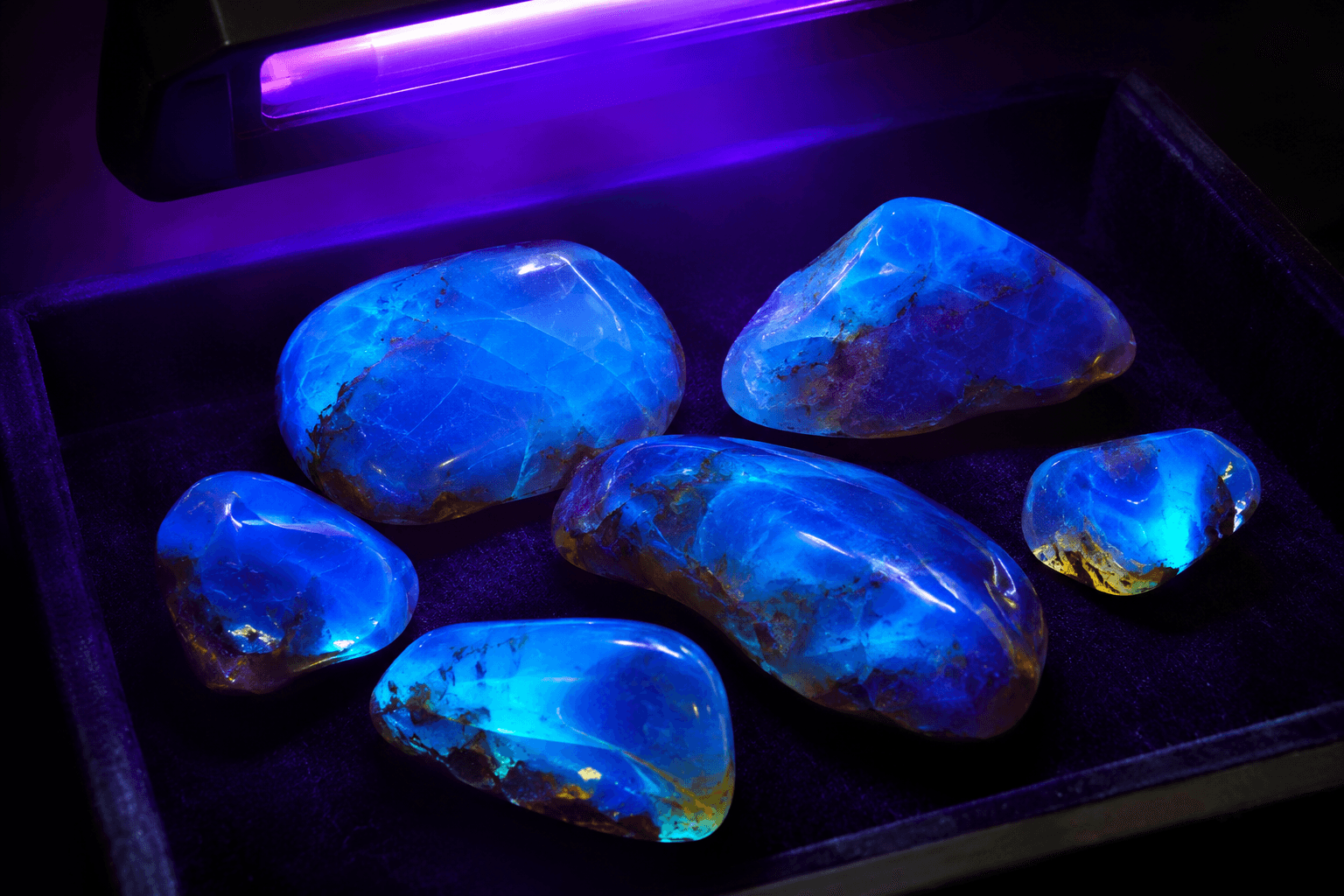
Indonesian blue amber is one of the few organic gems that can look like an ordinary brown resin in one light and flash electric blue in another. The material most collectors associate with Indonesia comes from coal seams in the Sinamar Formation of Jambi Province, Sumatra, in the foothills of the Bukit Barisan range. It is not a mineral: it is fossilized tree resin, usually honey-brown to near-black in body color, with a blue glow that is produced by fluorescence rather than pigment.
This guide focuses on identification. It explains what creates the blue glow, how Indonesian material differs from Baltic and Dominican amber, and which simple tests can support an authenticity claim before you buy a specimen or cabochon.
What Indonesian Blue Amber Really Is
Blue amber is fossilized resin. In Sumatra it is recovered from coal-bearing sediments and is commonly described as Miocene in age, roughly 23 to 30 million years old. Its body color ranges from pale honey and cognac to deep tea-brown or nearly black. The blue is not the body color; it is a surface effect created when ultraviolet light interacts with aromatic hydrocarbons in the resin.
Mineralogical databases describe the Sinamar material as "black amber" because of its dark base. That dark base is useful to collectors because it makes the blue fluorescence read more dramatically against a dark background or in daylight.
Why It Glows Blue
The blue glow comes from fluorescence. Trace molecules in the resin, especially perylene and related polycyclic aromatic hydrocarbons (PAHs), absorb ultraviolet and violet light and re-emit it as visible blue light. Published fluorescence measurements for blue amber report emission in the blue region, around 450 to 508 nm. Because the process is fluorescence, the glow stops when the exciting light is removed; blue amber is not phosphorescent.
Two factors make the glow visible:
- Chemistry: the aromatic hydrocarbons absorb high-energy UV and re-emit lower-energy blue light.
- Surface scattering: the glow is strongest where light enters and leaves the surface, so polish, texture, and viewing angle matter.
A freshly polished surface often shows the strongest color. A dark background, dim room, and a 365 nm long-wave UV source make the effect easiest to see. Ordinary daylight also contains enough UV to trigger a visible blue flash, especially in Sumatran material with a dark body color.
Indonesian, Dominican, and Baltic Amber
Geography changes the chemistry and the fluorescence.
| Origin | Resin class | Typical fluorescence | Notes |
|---|---|---|---|
| Sumatra, Indonesia | Retinite (low or no succinic acid) | Strong blue under 365 nm UV | Miocene to Pliocene; Sinamar Formation, Jambi Province |
| Dominican Republic | Retinite (low or no succinic acid) | Strong blue under 365 nm UV | Miocene; Hymenaea protera source tree |
| Baltic region | Succinite (succinic acid-rich) | Weak yellow-green; not blue | Eocene; the classic golden amber |
Both Sumatran and Dominican material can show strong blue fluorescence. The UV test confirms that a piece behaves like genuine blue amber, but it does not by itself prove origin. Baltic amber is the easiest to separate because it usually fluoresces yellow-green and never reads blue.
Practical Identification Tests
No single test is conclusive. The strongest approach is to stack several independent checks.
1. 365 nm UV Test
Use a 365 nm long-wave UV lamp in a dark room. Genuine blue amber usually floods with an intense electric blue or violet-blue that sits on the surface. Under short-wave UV (254 nm) the same material can fluoresce blue, but usually less brightly. Some Sumatran specimens also show a brief yellow-green afterglow after long-wave exposure.
2. Saltwater Float Test
Genuine amber has a specific gravity of about 1.05 to 1.10, so it floats in saturated salt water. Many plastics and glass sink. Copal can also float or hover, so this test separates amber from glass and many plastics but not from young resin.
3. Hardness and Touch
Blue amber is soft, about Mohs 2 to 2.5, and feels warm and light for its size. It should feel organic rather than cold and stony. Use this as a supporting clue, not as proof.
4. Hot-Needle Scent Test
This is destructive and should be a last resort on rough or an inconspicuous spot. Genuine amber gives a resinous, pine-like scent. Plastic tends to smell acrid or chemical and may melt aggressively. Copal melts more easily and smells strongly of fresh pine.
5. Body Color in Daylight
In normal light, blue amber should read honey, cognac, or dark brown. The blue appears under UV or in sunlight. Be cautious with listings that show only a solid blue stone and no fluorescence demonstration.
What These Tests Cannot Prove
UV fluorescence is strongly suggestive, but some modern plastics and copal can also fluoresce a bluish tone. Saltwater and hardness tests do not establish geological origin. For expensive jewelry, matched pairs, or investment-grade specimens, request origin documentation and consider testing by a qualified gemological laboratory. For expensive pieces, GIA-style documentation and treatment disclosure are worth requesting.
Care and Jewelry Use
Because blue amber is soft and organic, it is best in protected settings such as pendants, earrings, and brooches. Avoid ultrasonic cleaners, steam, harsh chemicals, prolonged heat, and direct prolonged sunlight. Store it in a cool, dark place. A gentle wipe with a soft cloth is usually enough.
Collecting Indonesian Blue Amber
Indonesian blue amber is attractive because its dark body can make the fluorescence read almost neon. Collectors often look for strong surface glow, clean polish, interesting inclusions, and documented locality. If you are comparing rough and finished pieces, RENDI VIRGO's catalog is a useful starting point: browse natural stone specimens, rough lapidary material, and the full shop.
FAQ
Is Indonesian blue amber a mineral?
No. It is fossilized tree resin, an organic gem. Its chemistry is hydrocarbon-based rather than crystalline silica or oxide.
Does a 365 nm UV glow prove that a stone is from Sumatra?
No. The UV test supports authenticity, not origin. Both Sumatran and Dominican blue amber can fluoresce blue. Ask for locality documentation when origin matters.
Can blue amber be faked?
Yes. Glass, plastic, pressed resin, copal, and assembled stones can imitate color or weight. Stacking UV, float, hardness, and scent tests reduces risk, but laboratory verification is best for high-value pieces.
Is blue amber durable enough for rings?
It is softer than most gemstones, so ring use requires a protective setting and careful wear. Pendants and earrings are safer choices.
What is the best lighting for viewing the blue glow?
A dark room with a 365 nm long-wave UV lamp gives the strongest effect. Daylight can also trigger a visible blue flash, especially against a dark background.