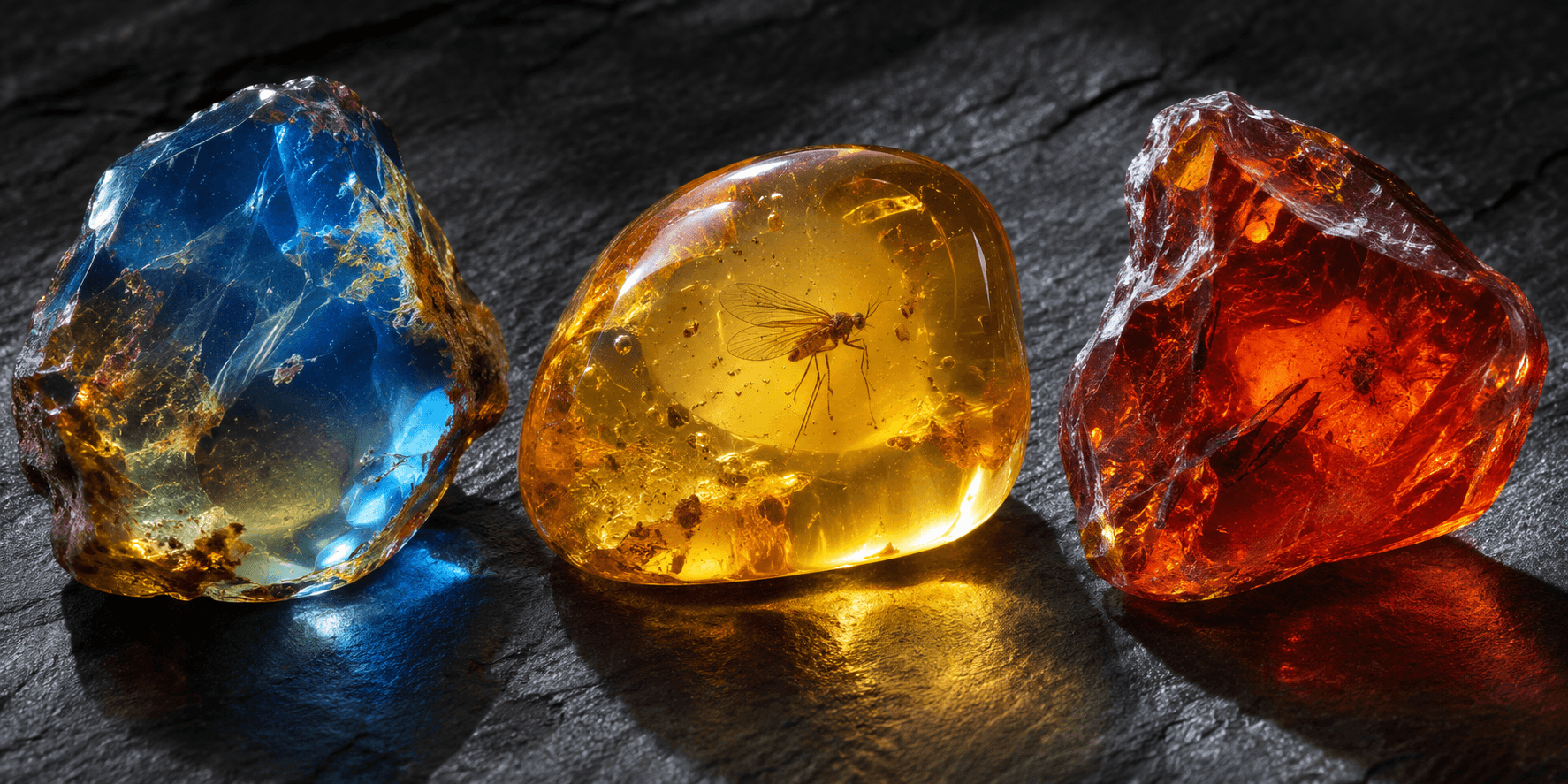
Indonesian blue amber from Sumatra is one of the most distinctive fossil resins on the market, famous for a vivid blue glow under sunlight. Collectors often compare it with the two better-known sources, Baltic and Dominican amber. Each origin has a different geological story, age, chemistry, and market value. Understanding these differences is the key to buying authentic material and pricing a collection correctly.
What Amber Actually Is
Amber is fossilized tree resin, not sap. Resin is a defensive secretion rich in volatile terpenoids; over millions of years it loses volatiles, polymerizes, and hardens into a durable organic gemstone. Because it is organic, amber is relatively soft (Mohs 2 to 2.5) and light (specific gravity about 1.05 to 1.10). It can float in saturated salt water, a property still used in simple field tests. Amber occurs worldwide, but only a few deposits yield gem-quality, transparent material in quantity.
Indonesian Blue Amber (Sumatra)
Formation and Locality
Indonesian blue amber is recovered mainly from coal-bearing sediments in Sumatra, associated with Tertiary angiosperm (flowering plant) forests that grew in warm, humid conditions. The resin was buried in swamp and delta environments, then subjected to moderate heat and pressure. The host rock is typically a lignite or sub-bituminous coal seam, which explains the dark, almost black body color of much Indonesian material.
The Blue Fluorescence
The signature feature is a strong blue to bluish-white fluorescence visible in daylight, especially under direct sun or UV. Unlike most amber, which fluoresces weakly, Indonesian blue amber contains aromatic hydrocarbons and polycyclic compounds that absorb UV and re-emit blue light. The effect is most striking on dark, opaque pieces; translucent honey-colored Sumatran amber exists but is less common and less fluorescent.
Typical Inclusions
Inclusions are less frequent than in Baltic or Dominican amber because the resin flowed in swamp settings and was often reworked. When present, they include plant fragments, bark, and occasionally insects. The dark matrix can make inclusions hard to see without backlighting.
Baltic Amber
Age and Geology
Baltic amber is Eocene in age, roughly 44 million years old, and is the world's largest amber deposit. It formed from coniferous forests around the Baltic Sea and is now mined primarily in Kaliningrad (Russia), Lithuania, and Poland. Much of it is recovered from "blue earth" (glauconitic sand) and from secondary deposits washed onto beaches.
Succinic Acid
Baltic amber contains 3 to 8 percent succinic acid, which gave rise to the old name "succinite." This acid is sometimes cited in folk medicine, though gemologically it mainly serves as an identification marker. Succinic acid content is not a universal feature of all amber; Indonesian and Dominican material generally lack it.
Color Range
Baltic amber ranges from pale yellow and honey to cognac, cherry red, and rare "bone" (opaque white) varieties. Blue Baltic amber exists but is extremely rare and usually results from surface oxidation or thin-film interference rather than bulk fluorescence.
Dominican Amber
Tropical Forest Origin
Dominican amber is Miocene, about 15 to 20 million years old, formed in a tropical forest dominated by Hymenaea (legume) trees. It is mined in the Cordillera Septentrional, notably near Santiago and in the Palo Alto and La Toca mines.
Insect Inclusions
Dominican amber is prized for exceptional, three-dimensional insect and plant inclusions, often better preserved than in Baltic material. The resin was less viscous, trapping organisms with fine detail.
Fluorescence
Some Dominican amber fluoresces blue or green under UV, but the effect is usually weaker and less consistent than in Indonesian blue amber. Color in Dominican material tends toward honey, cognac, and rare blue or green hues caused by fluorescence in the resin itself.
Side-by-Side Comparison
| Feature | Indonesian (Sumatra) | Baltic | Dominican |
|---|---|---|---|
| Age | Tertiary (younger) | ~44 Ma (Eocene) | ~15-20 Ma (Miocene) |
| Host rock | Coal / lignite | Glauconitic sand | Sedimentary, volcanic |
| Body color | Dark brown to black | Yellow to cognac | Honey to cognac |
| Blue fluorescence | Strong, daylight-visible | Rare / weak | Weak to moderate |
| Succinic acid | No | Yes (3-8%) | No |
| Inclusions | Rare | Common | Very common, detailed |
| Mohs hardness | ~2-2.5 | ~2-2.5 | ~2-2.5 |
Identifying Authentic Indonesian Blue Amber
UV and Daylight Test
View the stone in direct sunlight; authentic Indonesian blue amber shows a distinct blue glow. Under a 365 nm UV lamp the fluorescence is bright blue-white. Be aware that some sellers coat or irradiate pale amber to mimic the effect; such treatments usually look patchy and fade.
Refractive Index and Specific Gravity
Refractive index is typically 1.540 to 1.545; specific gravity 1.05 to 1.10. These values overlap with other ambers, so they confirm amber rather than identify origin.
Red Flags
- Uniform, too-perfect blue on light-colored material (often dyed or coated).
- No fluorescence under 365 nm UV.
- Price far below market for the size (likely copal or plastic).
- "Blue amber" that is actually blue calcite or glass.
Value and Collecting
Value depends on size, fluorescence intensity, translucency, and inclusion quality. Dark, strongly fluorescent Indonesian pieces command premium prices, especially as cabochons and display specimens. Baltic amber is valued for succinite content and warm colors; Dominican for inclusions. For a collector, owning one strong example of each origin is more informative than several similar pieces.
Care and Storage
Amber is soft and heat-sensitive. Store away from direct heat and prolonged sunlight (which can darken or craze the surface). Clean with lukewarm water and mild soap; avoid solvents, ultrasonic cleaners, and steam. Wrap pieces individually to prevent scratching.
FAQ
Is Indonesian blue amber real amber?
Yes. It is fossilized tree resin from Sumatra, chemically an amber, distinguished by strong blue fluorescence.
Why does Indonesian amber glow blue?
Aromatic compounds in the resin absorb UV and re-emit blue light; the effect is strongest in dark, opaque Sumatran material.
Is Baltic amber more valuable than Indonesian?
Not necessarily. Fine, strongly fluorescent Indonesian pieces can exceed common Baltic material in price; value depends on quality, size, and fluorescence.
How can I tell amber from copal?
Amber is fully fossilized and insoluble in acetone; copal (younger resin) softens or becomes tacky. A hot-needle test on an inconspicuous spot is another classic method.
Conclusion
Indonesian blue amber, Baltic amber, and Dominican amber represent three different windows into ancient forests. For collectors and jewelry makers, the choice comes down to fluorescence and drama (Indonesia), warmth and tradition (Baltic), or inclusion detail (Dominican). Explore our natural stone catalog for available amber and related materials, browse finished cabochons, or request custom cutting through our lapidary service. For raw material, see rough lapidary stock.