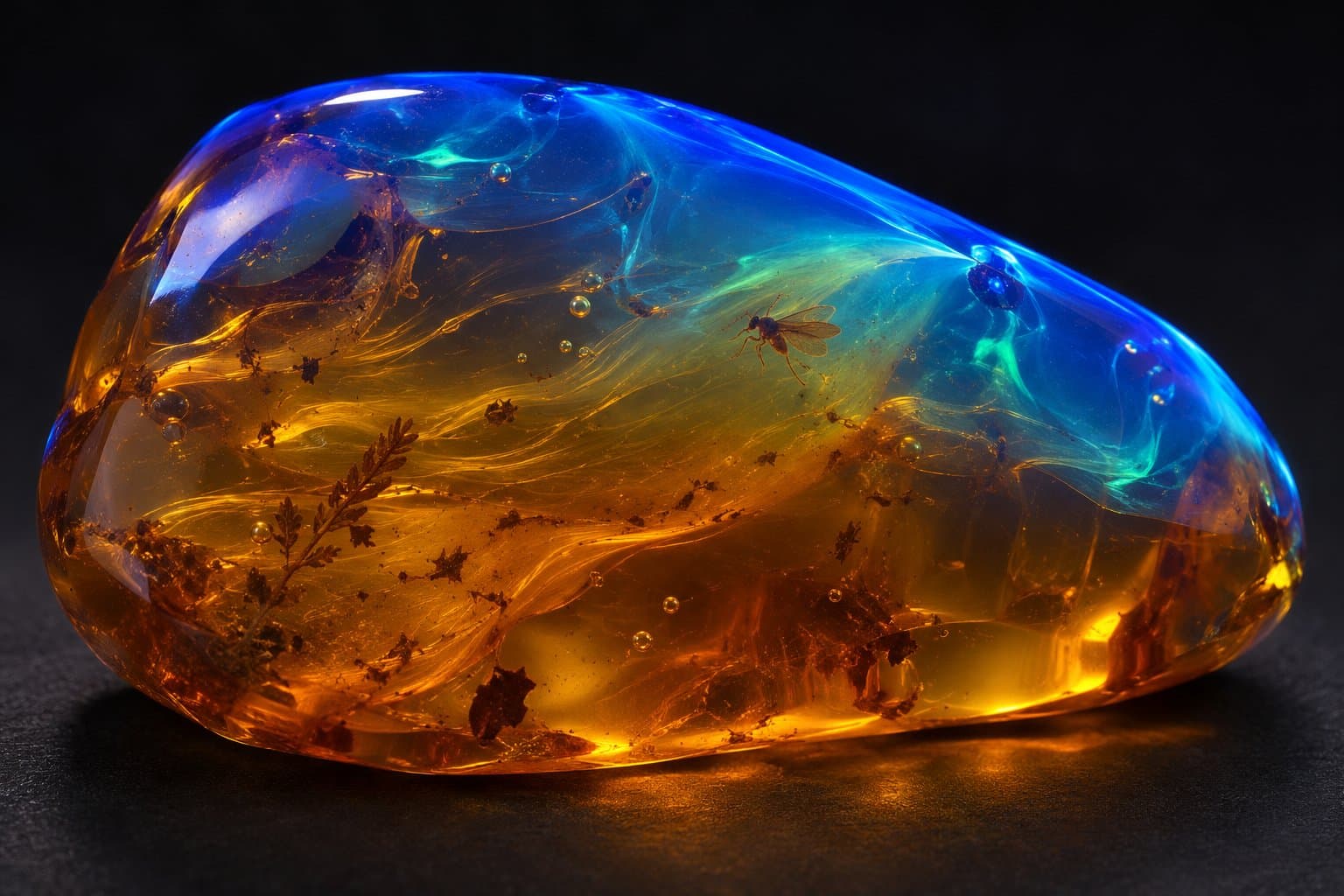
Indonesian blue amber is fossilized tree resin from Sumatra that reads honey-brown to near-black indoors, yet flashes an unmistakable electric blue in direct sunlight or under a 365 nm UV lamp. Only two places on Earth consistently produce this material — Sumatra and the Dominican Republic — which makes authentic Sumatran blue amber one of the most sought-after collectibles in the modern organic-gem market.
This guide covers the geology behind the glow, how the Sumatran deposit compares with Dominican resin, and the test battery gemologists run before a purchase.
Why Blue Amber Glows: Fluorescence, Not Body Color
This is a surface phenomenon, not a pigment. Under ordinary shop lighting the stone is a dark cognac, cola-brown, or almost black — Indonesian dealers call the darkest grade "black amber." The blue appears only when high-energy light strikes the surface.
The cause is fluorescence. Trace organic molecules — perylene and related polycyclic aromatic hydrocarbons (PAHs) — absorb ultraviolet and violet light and re-emit it as visible blue, with surface light scattering adding to the effect. Because the glow is fluorescence, it dies the instant the light is removed: blue amber is fluorescent, never phosphorescent.
GIA researchers have measured this directly. Gems & Gemology (Summer 2014) documented Indonesian blue amber rough showing very strong greenish blue fluorescence under long-wave (365 nm) UV, only weak fluorescence under short-wave (254 nm) UV, and emission peaks near 450, 485, and 500 nm (GIA, Color Phenomena of Blue Amber). The same study notes a bench detail collectors can use: UV does not penetrate deeply into amber, so the blue stimulation stays in a thin surface layer while the interior bodycolor holds.
The Daylight Test
Strong Sumatran material does not need a lamp. Direct sunlight triggers the same blue response — hold the stone against a dark background outdoors and a genuine, high-grade piece presents a saturated blue-to-greenish blue face. The strongest, most even daylight glow is also a quality marker for the best Sumatran nodules.
Geology and Origin: The Sinamar Formation, Sumatra
Indonesian blue amber comes from coal-bearing layers of the Sinamar Formation in the South Sumatra Basin, in the foothills of the Bukit Barisan range. The amber-bearing strata host hard, banded coal, and resin nodules concentrated in specific seams are recovered during coal-mining activity. The deposit dates to the Oligocene, roughly 30 million years ago — older than most Dominican material.
The source trees belong to the Dipterocarpaceae family, most likely Shorea. That lineage matters: dipterocarp resin chemistry differs from the legume resin of the Dominican Republic, and FTIR spectroscopy separates the two profiles — a scientific check on disputed origins.
Amber itself is soft and remarkably light: specific gravity near 1.05–1.10, Mohs hardness around 2–2.5, refractive index close to 1.54 — properties that shape both identification and cutting (below). Browse our shop catalog to see how each mineral and fossil-resin listing documents origin, unit, and condition.
Sumatra vs. Dominican Republic vs. Baltic: Who Makes What
| Feature | Sumatra, Indonesia | Dominican Republic | Baltic |
| --- | --- | --- | --- |
| Age | ~30 Ma (Oligocene) | Oligocene–Miocene | ~40 Ma (Eocene) |
| Source tree | Dipterocarpaceae (Shorea) | Hymenaea protera (extinct) | Pinus (conifer) |
| Resin class | Retinite (low succinic acid) | Retinite (low succinic acid) | Succinite (succinic acid) |
| Bodycolor | Deep honey to cola / "black amber" | Lighter, brighter honey | Yellow to golden |
| Blue glow | Strong, even; daylight-visible | Strong under UV | None |
The comparison is not cosmetic. Genuine blue fluorescence has never been confirmed in Baltic material — Baltic succinite lacks the chemical environment that produces blue-fluorescing compounds — so Sumatran and Dominican amber are the only two jewelry-grade blue sources with documented origin. GIA's 2020 study measured Dominican blue amber emitting strongest, with narrow triple peaks near 450, 474, and 508 nm and distinctive absorption features at 412 and 441 nm — proof that provenance is measurable, not an assertion (GIA, Fluorescence Characteristics of Blue Amber).
For collectors weighing a display specimen, locality documentation is part of the value proposition. See the curated fossil and mineral specimen collection for examples of well-staged display material.
How to Identify Genuine Indonesian Blue Amber
No single home test is conclusive. Gemologists stack several cheap, fast checks, and a lab report remains the gold standard for high-value purchases.
Test 1: The 365 nm Ultraviolet Glow
Use a true long-wave 365 nm UV torch, not a cheap 395 nm "purple" flashlight — the violet wash it emits drowns the blue. Genuine blue amber fluoresces intense blue under 365 nm; the darker the bodycolor, the more dramatic the effect. A piece that reads flatly blue from every angle, with no honey or brown bodycolor visible from the side, is usually dyed resin.
Test 2: Density and Simple Bench Checks
Three checks anyone can run:
- Saltwater float. Amber's SG near 1.05–1.10 means it floats in saturated brine (~1.15–1.16) but sinks in fresh water. Most plastic and glass simulants sink in both.
- Acetone touch. A drop on a polished edge briefly dulls mature amber and it recovers; young copal turns tacky within seconds. (Test a hidden edge only.)
- Feel and scratch behavior. Amber is warm to the touch, light in hand, and scratches around Mohs 2–2.5 — far softer than glass.
Test 3: Lab Confirmation
For anything above a modest price, insist on an FTIR-backed report from GIA or IGI. FTIR separates retinite (Sumatran and Dominican) from Baltic succinite, separates amber from copal, and catches polymer reconstruction. High-value identification always combines the emission spectrum with the infrared fingerprint.
For nodule rough and cabochon-grade material, the sourcing questions are the same as for agate and jasper — check the rough lapidary material collection to see how provenance is documented on every listing.
Lapidary and Care: Working with a Soft Organic Gem
Blue amber scratches easily (Mohs 2–2.5), and heat or solvents are real hazards. Practical rules:
- Cut with care. Fine grinding stages, minimal pressure, plenty of coolant; resin melts into wheel grit at high temperature and reappears as a dull haze.
- Shape and set. Favor cabochons and freeform dome profiles with a protective bezel rather than prongs.
- Never ultrasonic-clean. Heat-cycling and steam damage the resin. Clean with mild soap and water.
- Store separately. Keep amber away from hard gemstones in the same tray, and away from prolonged direct UV — chronic exposure fades and crazes the surface.
- Avoid perfumes and solvent sprays. Cosmetic chemicals can dull or etch the surface permanently.
Handled correctly, a polished Sumatran nodule is a stable, long-lived display material — one of the few organic gems whose most dramatic look needs nothing more than a sunny window and a dark backdrop.
FAQ
What causes the blue glow in Indonesian blue amber?
Fluorescence. Trace perylene and related PAH molecules in the resin absorb UV and violet light and re-emit it as blue. GIA-measured emission peaks sit near 450–500 nm for both Sumatran and Dominican material, and the glow stops the instant the light is removed.
Is Sumatran blue amber older or younger than Baltic amber?
Baltic succinite is older, roughly 40 million years (Eocene). Sumatran blue amber dates to around 30 million years (Oligocene), from coal seams of the Sinamar Formation in the South Sumatra Basin.
How can I tell genuine blue amber from dyed resin?
Stack the 365 nm long-wave UV glow, a daylight blue check on a black background, and the saltwater float test. Real blue amber keeps its honey-to-brown bodycolor when viewed from the side; a piece that reads flat blue from every angle is usually dyed resin. For high-value stones, request an FTIR report.
Does Indonesian blue amber differ from Dominican blue amber?
Three differences matter. Sumatran material is mostly darker ("black amber") with a stronger, more even daylight glow; Dominican pieces are lighter. The source trees differ — Dipterocarpaceae Shorea versus the extinct Hymenaea protera. And GIA's 2020 measurements show Dominican material fluorescing slightly stronger under 365 nm UV.
Where to See and Buy Well-Documented Blue Amber
Collectors and lapidary buyers should insist on locality information and photographic evidence for every piece. Browse the full RENDI VIRGO catalog for the current inventory of Indonesian fossil resins, gem material, and collector-ready rough.