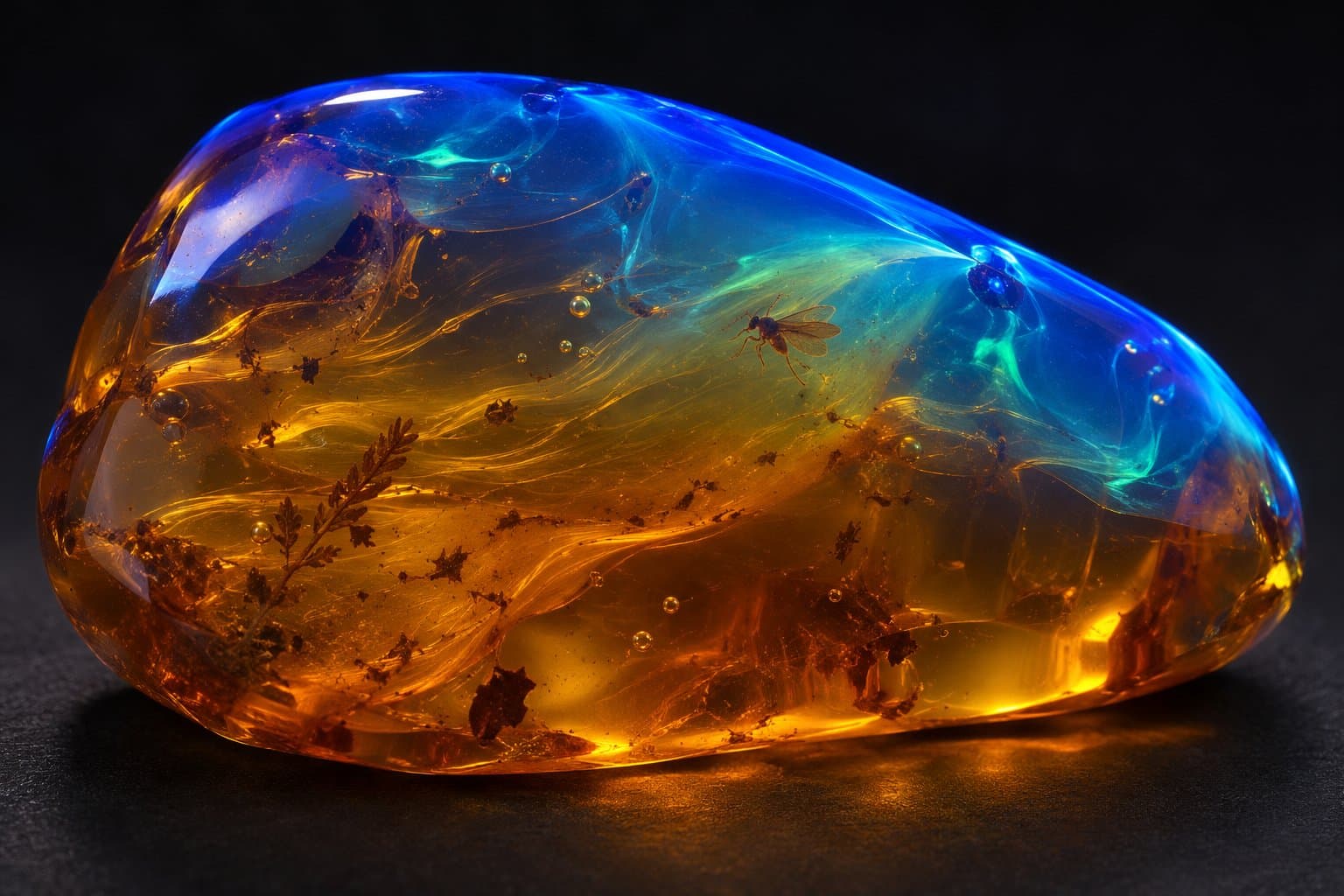
Indonesian blue amber is one of the most rewarding—and least forgiving—materials on a lapidary bench. It is soft enough to shape quickly, but its beauty depends on fragile polycyclic aromatic hydrocarbons (PAHs) that create the cobalt glow. Heat, aggressive abrasives, or careless polishing can dull that glow permanently. This guide focuses on practical, low-risk methods for cutting, shaping, and polishing Indonesian blue amber into cabochons, beads, and small carvings.
What Makes Indonesian Blue Amber Different in the Lapidary Shop
Most Indonesian blue amber comes from the coal seams of Sumatra's Bukit Barisan range, especially the Talang Akar and Sinamar formations, and is Miocene in age (roughly 10–30 million years). It formed from Dipterocarpaceae resin—most likely Shorea—rather than the Hymenaea that produced much Dominican amber. The result is a dark, smoky body with strong daylight fluorescence and, in many pieces, a vivid electric-blue response under 365 nm UV-A.
For the lapidary, three properties matter more than origin:
- Hardness: about Mohs 2–2.5, comparable to other ambers.
- Specific gravity: about 1.05–1.10, so it feels light in the hand.
- Thermal sensitivity: PAH fluorescence can be degraded by prolonged heat above about 60 °C, and amber itself softens and can craze under friction.
The dark body color that makes Sumatran material so dramatic also hides fractures. Inspect rough under a strong raking light and, when possible, a 10x loupe before committing to a cut.
Before You Cut: Reading the Rough
Start by deciding what the piece wants to become. Blue amber is usually cut as cabochons, beads, or small freeform carvings; faceting is possible but the softness makes facet edges vulnerable.
- Look for fractures. Surface-reaching cracks often follow stress lines from mining or drying. Mark them with a wax pencil.
- Check the rind. The outer weathered skin can act as a natural optical mirror. If fluorescence is strongest near the surface, plan cuts that preserve at least part of that rind.
- Orient for glow. Face the finished cabochon toward the thickest, darkest teal area to maximize the daylight gradient.
- Keep pieces cool and dry. Do not leave rough in a hot car or in direct sun; thermal shock can start crazing before you touch a wheel.
If a nodule is large enough, consider cutting a test slab first. A thin slice reveals inclusions, flow lines, and fracture density without risking the whole piece.
Safe Cutting and Grinding
Amber cuts fast, which is both an advantage and a trap. The goal is to remove material without letting friction heat the stone.
- Use low speed and light pressure. Let the abrasive do the work; pressing harder only generates heat.
- Keep the stone wet. Water lubrication carries heat away and reduces dust. Wipe and inspect frequently so you can see fracture lines.
- Prefer fine grits as you approach the final shape. Coarse removal is quick, but deep scratches in soft amber take longer to erase than in harder stones.
- Avoid dry sanding for more than a few seconds. If the stone becomes warm to the touch, stop and let it cool.
- Amber melts at roughly 170–190 °C. You will not reach that temperature with proper cooling, but localized friction can still scorch the surface.
Traditional lapidary references describe amber as easy to file and sand with aluminum oxide paper in progressively finer grades (about 200, 400, and 600 grit), followed by polishing compounds such as tripoli with oil, tin oxide, Linde A, or dry rouge. Diamond wheels can be used, but choose fine grits and a gentle touch; coarse diamond can tear the surface.
For cabochons, work the girdle first, then establish a low to medium dome. Very high domes concentrate impact on a soft stone and can expose thin, fragile edges.
Polishing Without Killing the Glow
Polishing is where many blue amber pieces lose their character. Two mistakes are common: too much heat and too much removal.
- Do not over-polish. The natural rind sometimes acts as an internal mirror. Removing it can flatten the glow.
- Keep compounds gentle. Use a soft backing, light pressure, and short polishing intervals. Check the surface temperature often.
- Test on a scrap. Before polishing a finished piece, try your compound and speed on an offcut from the same rough.
- Finish by hand. A final light buff with a soft cloth can restore surface lustre. Some lapidaries use a tiny drop of olive oil buffed off completely; test first and avoid leaving residue.
If the piece looks hazy or grey after polishing, the PAH layer near the surface may have been oxidized. In that case, re-cutting a fresh surface is usually the only reliable fix.
Care, Storage, and Repair
Finished blue amber remains sensitive. Advise customers—and remind yourself—to follow these rules:
- Clean with a soft, damp microfiber cloth and mild soap. Dry immediately.
- Never use ultrasonic cleaners, steam, boiling water, alcohol, acetone, perfume, or commercial jewelry dips.
- Store in a padded pouch at moderate humidity. A nearby silica pack is useful, but do not seal amber airtight; it benefits from a small amount of air exchange.
- Keep pieces away from radiators, hot cars, and prolonged direct sunlight.
Light surface scratches can often be buffed out by an experienced lapidary because the low hardness makes re-polishing straightforward. Deep cracks, however, usually require re-cutting.
Sourcing and Ethical Context
Sumatran blue amber is typically recovered as a byproduct of coal mining, with artisanal miners collecting nodules from highland creek beds after heavy rains. That context matters for both provenance and supply: pieces with documented locality, formation, and mining method are easier to value and resell. When buying rough, ask for origin details and, for high-value material, consider FTIR spectroscopy for definitive identification.
RENDI VIRGO sources Indonesian rough and finished stones with locality in mind. You can browse available material in our rough materials collection, explore finished cabochons, or request custom lapidary work. For display-grade pieces, see our mineral specimens.
FAQ
Can I cut blue amber with diamond wheels?
Yes, but use fine grits, light pressure, and continuous water cooling. Coarse diamond and high speed can tear or heat the surface. Many lapidaries prefer files and fine aluminum oxide paper for the final shaping.
Why did my blue amber turn dull after polishing?
The most likely causes are heat oxidation of surface PAHs or over-polishing that removed the natural rind. Reduce speed, keep the stone wet, shorten polishing intervals, and test your compound on an offcut first.
Is Indonesian blue amber suitable for everyday jewelry?
It can be worn regularly in pendants and earrings, but its Mohs 2–2.5 hardness means it scratches and chips easily. Use protective settings, avoid rings that take impact, and keep pieces away from heat and solvents.
How can I verify blue fluorescence?
View the stone against a dark background in daylight; Sumatran material often shows a visible cobalt glow. For a stronger test, use a 365 nm UV-A lamp. For high-value pieces, professional FTIR spectroscopy provides definitive identification.
RENDI VIRGO is an Indonesian natural stone and lapidary studio specializing in cabochons, rough materials, carvings, and mineral specimens.