
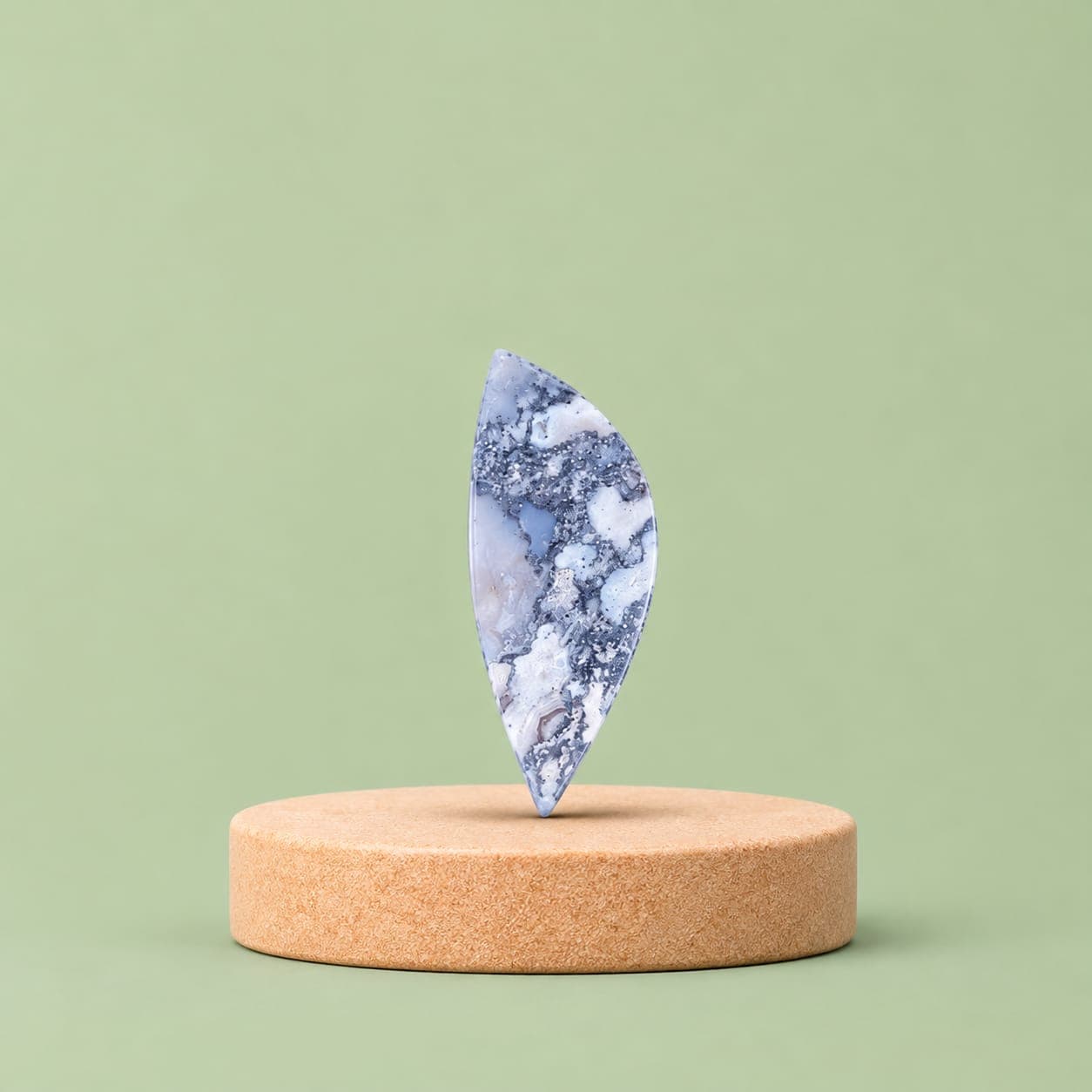
Maligano Jasper is one of Indonesia's most distinctive lapidary stones: an opaque, brecciated chalcedony from Sulawesi whose fractured mosaic of angular fragments, dark webbing and lavender accents looks almost like a stained-glass window cut from earth tones. Although it reached the international market only around 2011, it has become a favorite of cabochon cutters and mineral collectors who want a pattern-rich stone that is hard enough for everyday jewelry.
What Is Maligano Jasper?
Maligano Jasper is a trade name for a brecciated chalcedony - microcrystalline quartz (SiO2) - quarried near the village of Maligano on Sulawesi, Indonesia. Like all chalcedony, it belongs to the quartz family and shares the mineral's durability. What sets it apart is its texture: instead of the smooth, parallel banding of agate, Maligano shows angular rock fragments (clasts) cemented back together by later silica, producing a cracked-mosaic or webbed face.
The stone is fully opaque in most pieces, with occasional translucency in thin chalcedony veins. Colors range through grey, white, cream, tan, brown, red, orange and purple, often with black veining. Because it is sold under a locality-based trade name rather than a formal mineral species, quality varies widely; the best material shows crisp, high-contrast webbing and clean polish.
Formation and Locality
Maligano Jasper formed in a volcanic, silica-rich environment. Silica-bearing hydrothermal fluids filled fractures and cavities in older host rock; episodes of brecciation - shattering followed by recementation with fresh silica - created the angular clast mosaic. Iron and manganese oxides supplied the red, orange and lavender tones, while later silica veins drew the dark webbing.
Deposits are reported from the Maligano area of Sulawesi (Celebes), Indonesia, collected from limited surface and shallow workings. This restricted, small-scale supply is part of why fine material commands a premium and why locality documentation matters to collectors.
Mineralogy and Key Properties
Maligano Jasper inherits the properties of quartz-family chalcedony, well documented in standard gemological references (GIA, Gem-A, mindat):
- Composition: Silicon dioxide (SiO2), microcrystalline quartz.
- Hardness: Mohs 6.5-7 - hard enough to scratch glass and resist everyday wear.
- Specific gravity: About 2.6, typical of quartz.
- Streak: White.
- Luster: Waxy to dull on rough; glassy on a polished face.
- Transparency: Opaque, occasionally translucent in thin veins.
- Cleavage/Fracture: No cleavage; conchoidal to splintery fracture.
- Acid reaction: None - silica, not carbonate, which separates it from veined marbles.
These numbers make Maligano a practical jewelry stone: it takes a bright polish, resists scratching and is stable in normal wear.
How to Identify Maligano Jasper
- Confirm quartz-family material. It should feel dense and fine-grained, with a waxy feel and conchoidal fracture.
- Look for the breccia pattern. Angular broken fragments rejoined by lighter or contrasting silica veins are the defining trait.
- Test hardness. It scratches glass and steel (Mohs ~6.5-7).
- Check the streak. White.
- Inspect the polished face for the characteristic cracked-mosaic or webbed look.
- Rule out look-alikes. It does not fizz in acid (unlike marble, Mohs ~3), and unlike agate it shows no translucent banding.
Ask sellers for untreated, natural-light photographs, locality information and disclosure of any dye, resin filling or stabilization.
Maligano Jasper vs Similar Stones
- Brecciated agate: shows translucent banding; Maligano is mostly opaque with denser web patterns.
- Picture/Picasso jasper: displays flowing landscape scenes rather than an angular fractured mosaic.
- Generic brecciated jasper: differs mainly in locality and the fineness of the net veining, not in base properties.
- Veined marble: much softer (Mohs ~3) and reacts to acid; Maligano does not.
Lapidary and Jewelry Uses
Maligano Jasper is primarily a collector and lapidary stone, cut into cabochons, slabs and freeform display pieces that showcase its scenic patterns. Practical tips:
- Orientation: Rotate the slab before cutting to place the strongest webbing and color contrast where the eye lands; the pattern is directional.
- Cabochon domes: a medium dome suits the opaque body and shows the mosaic without distortion.
- Slabbing: use a diamond blade and steady feed; the stone is hard but brittle along fracture lines.
- Polishing: progress through fine grits and finish with cerium oxide or diamond polish for a glassy face.
- Pairing: warm earth tones pair well with silver or copper settings; lavender accents suit rose gold.
Browse our cabochon collection for cut stones, rough material for slabbing stock, and display specimens for finished pieces. Our custom lapidary service can cut Maligano to your design.
Care, Storage and Valuation
Care is straightforward: rinse with lukewarm water, dry with a soft cloth, and avoid harsh chemicals, ultrasonic cleaners and sudden temperature shocks. Store separately to prevent harder stones from scratching its polish; some collectors avoid prolonged direct sunlight to preserve color vibrancy.
Value depends on pattern complexity and contrast, color saturation (especially lavender and red accents), size, structural integrity (no open fractures), and documented Sulawesi locality. Untreated, naturally polished material with crisp webbing commands the highest prices. See our full catalog for current availability.
FAQ
Is Maligano Jasper a real jasper?
It is a brecciated chalcedony - microcrystalline quartz - sold under the trade name Maligano Jasper. Mineralogically it is chalcedony, not the opaque jasper of older classifications, but the trade name is standard in the lapidary market.
Where does Maligano Jasper come from?
From the Maligano area of Sulawesi, Indonesia, collected from limited surface and shallow deposits since about 2011.
How hard is Maligano Jasper?
Mohs 6.5-7, with a specific gravity near 2.6 and a white streak. It scratches glass and is suitable for rings and bracelets with normal care.
Can Maligano Jasper be dyed or stabilized?
Some material on the market may be dyed or resin-stabilized to enhance color or fill fractures. Ask for untreated, natural-light photos and disclosure of any treatment before buying.